How the brain and body respond to stress and to what matters to you, what research can and cannot tell us, and how to notice your reactions with curiosity.
Quick reactions can feel as if they come from nowhere. This module explains, in plain words, what researchers know and do not yet know about how the brain and body respond. It will not tell you why you react the way you do, and it does not diagnose anything. It offers ideas you can use to notice your own reactions with curiosity.
About 12 min read
A note on safety. This page explains research about the brain and body. It is education, not therapy, and it is not a diagnosis.
You do not need to read it all. Stop whenever you like, and skip anything that feels like too much.
Reading about stress and fear can bring up strong feelings for some people. If that happens, pause, look around the room, and breathe out slowly.
If your reactions are affecting your sleep, work, health or relationships, a licensed professional can help you make sense of them.
Nothing you write in the tools on this page is sent anywhere.
What this module is about
Research-informed
A reaction is not one event in one place. Research describes brain networks, hormones, nerves, memory and the meaning you give to a situation all working together, and how this plays out differs from person to person. Your relationships and social setting also shape how you read and respond to events.
Researchers describe the amygdala and the prefrontal cortex as parts of wider networks rather than as single on/off switches (Šimić et al., 2021; Friedman & Robbins, 2022).
The body's stress systems, hormonal and nervous, are normal and often protective in the short term. How they respond varies between people and situations, and long or repeated activation can become harmful (Herman et al., 2016; Russell & Lightman, 2019).
Appraisal theories propose that how you evaluate a situation shapes the rest of your emotional response (Scherer & Moors, 2019).
Much of this research compares groups of people. It cannot tell you what is happening in one person.
A starting point: This module treats reactions as reflecting your current circumstances, your expectations, what you have learned over time, and your emotional state. It does not assume a specific cause in childhood. Not every reaction has a story from the past, and a reaction does not define who you are.
The brain and body parts involved
Research-informed
Each part below has its own fold. They describe where the part is, how it works, what that means in plain terms, and why it may matter in daily life. The names in brackets are the studies behind each statement, listed in full under Sources.
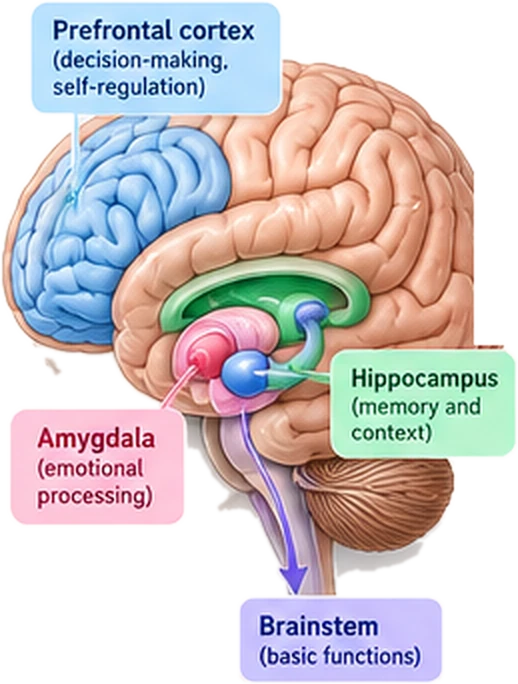
The adult brain, side view. Simplified educational illustration; labels in the image are in English. The wording in the image is simplified.Describe this illustration
A coloured side view of the inside of the brain, with the front of the head on the left. The prefrontal cortex is shaded blue at the front. Deep inside, the amygdala is shown in pink at the front end of the hippocampus, which curves back. The brainstem runs down from the base. Each part has a label box. The hypothalamus is not labelled in this picture. The labels are listed below because the words in the picture are in English.
A small, almond-shaped cluster of nuclei deep in the temporal lobe, in front of the hippocampus, one on each side. It responds to how important, new, uncertain or emotionally charged something is, not only to threat. It works within wider networks (Šimić et al., 2021).
Prefrontal cortex
The front part of the brain’s outer layer. It supports holding goals in mind, switching tasks and holding back impulses, through networks across the brain. It is not a boss that switches emotions off (Friedman & Robbins, 2022).
Hippocampus
A curved structure deep in the temporal lobe, one on each side. It is involved in memory for facts and events. Stress can change how well memory works, depending on timing (Shields et al., 2017). Whether adults make new neurons here is still debated.
Hypothalamus
A small structure deep in the middle of the brain, just above the pituitary gland. It is the first step in the stress hormone pathway (Herman et al., 2016). It is not labelled in the picture above.
The amygdala: helping the brain notice what matters
Research-informed
Where it is. The amygdala is a small, almond-shaped cluster of nuclei deep in the temporal lobe, in front of the hippocampus. There is one on each side of the brain. It responds to how important, new, uncertain or emotionally charged something is, not only to threat (Šimić et al., 2021). In animal studies, the central part of the amygdala and a neighbouring area help organise defensive responses. How fully this carries over to people is still being worked out (Fox & Shackman, 2019).
What it does. It keeps evaluating information from the senses and gives it a value, such as how pleasant or threatening something is and how intense. It also takes part in learning by association and in how the body responds (Šimić et al., 2021). It works as part of wider networks.
In plain terms. The amygdala helps the brain notice what matters to you, including possible threats. Many researchers describe it as part of a wider network rather than a single place where fear is made. In fear-learning experiments, a network of regions becomes active together (Fullana et al., 2016).
One proposal, not a settled fact. Some researchers suggest that the systems driving quick bodily defence responses are separate from those behind the conscious feeling of fear (LeDoux & Pine, 2016). If that is right, a fast bodily reaction and the feeling you name a moment later could be different processes.
Why this matters in daily life. A quick reaction does not, by itself, mean something is wrong with you. Brain scans show which regions are active together. On their own they show association rather than cause. Many scan studies use small samples, and large studies show that small samples can give unreliable results for links between brain and behaviour (Marek et al., 2022).
In PTSD research, circuits involving the amygdala, hippocampus and medial prefrontal cortex are studied closely, and PTSD is seen partly as fear processing that has become dysregulated (Ressler et al., 2022). For more on trauma, see Understanding trauma.
The prefrontal cortex: holding goals and choosing a response
Research-informed
Where it is. The prefrontal cortex is the front part of the brain's outer layer. It has several parts. Two that researchers often discuss are the ventromedial and the ventrolateral prefrontal cortex (Hiser & Koenigs, 2018; Morawetz et al., 2017).
What it does. It supports cognitive control: holding goals in mind, switching between tasks and holding back impulses. These abilities rely on networks across the brain, not on one region alone (Friedman & Robbins, 2022). The ventromedial part is involved in decisions, in social understanding, and in generating and regulating negative emotion through its links with the amygdala and other regions (Hiser & Koenigs, 2018).
In plain terms. The prefrontal cortex is not a boss that switches emotions off. It is one contributor to a wider system that helps you weigh a situation and pick a response. When people regulate emotion, whether by reframing or by other strategies, scans often show the left ventrolateral prefrontal cortex active together with other regions. This shows association, not that one region does the regulating alone (Morawetz et al., 2017).
Why this matters in daily life. In laboratory experiments, short-term stress tended to impair working memory and mental flexibility, though the effects varied and differed by sex (Shields et al., 2016). Most participants were healthy volunteers, so this is a short-term effect seen in a laboratory. Whether it carries over to feeling overwhelmed in daily life has not been shown.
In studies of people with mood or anxiety disorders, regulation networks were on average less active during reappraisal tasks than in comparison groups. The studies cannot show what causes that difference (Picó-Pérez et al., 2017).
The hippocampus: memory in context
Research-informed
Where it is. The hippocampus is a curved structure deep in the temporal lobe, one on each side of the brain. It includes an area called the dentate gyrus (Boldrini et al., 2018).
New neurons: still debated. Whether adults make new neurons in the hippocampus is still debated. Studies from 2018 onward disagree. Some find immature neurons or progenitor cells in adult and even older human brains, with large differences between people. Others find almost none, and the markers used are themselves contested (Dumitru et al., 2025; Franjic et al., 2022; Kempermann et al., 2018; Sorrells et al., 2018; Tobin et al., 2019; Moreno-Jiménez et al., 2019). Nothing here shows you can grow new neurons on purpose.
What it does. The hippocampus is involved in memory for facts and events, such as verbal recall (Kim & Kim, 2023). Stress can change how well memory works, and the effects depend on timing and circumstances (Shields et al., 2017).
In plain terms. In a large analysis of laboratory experiments, stress at the time of learning or recall usually made memory worse, while stress shortly after learning often helped it. The effects differed by timing, context and material (Shields et al., 2017). Stress also seems to weaken fact-based memory while sometimes strengthening emotional learning. Whether the hormone cortisol alone explains this is debated, and much of the supporting work is in animals (Kim & Kim, 2023).
What about size? Large studies find slightly smaller average hippocampal volume in people with PTSD and in people with recurrent depression. The differences are small. They cannot show whether stress caused them or whether they were there beforehand (Logue et al., 2018; Schmaal et al., 2016). These findings do not show that anyone's hippocampus has been damaged, and they say nothing about whether differences are permanent.
Why this matters in daily life. In laboratory studies, how well people remembered material depended on when the stress happened relative to learning or recall (Shields et al., 2017).
The hypothalamus: a link between brain and body
Research-informed
Where it is. The hypothalamus is a small brain structure deep in the middle of the brain, just above the pituitary gland.
What it does. In the stress pathway, the hypothalamus is the first step. It signals the pituitary, which signals the adrenal glands (Herman et al., 2016). Limbic structures such as the amygdala and hippocampus shape this response.
In plain terms. It is one part of a body-wide system, not a stress centre on its own. The HPA axis fold below explains the whole pathway.
The HPA axis and cortisol: the body's main hormone pathway for stress
Research-informed
Where it is. HPA stands for hypothalamus, pituitary and adrenal glands. The hypothalamus is a brain structure, the pituitary is a small gland at its base, and the adrenal glands sit above the kidneys and release cortisol.
In steps. (1) The brain detects a demand. (2) The hypothalamus signals the pituitary gland. (3) The pituitary signals the adrenal glands. (4) The adrenal glands release cortisol. (5) Cortisol feeds back to the brain, which normally switches the response off (Herman et al., 2016).
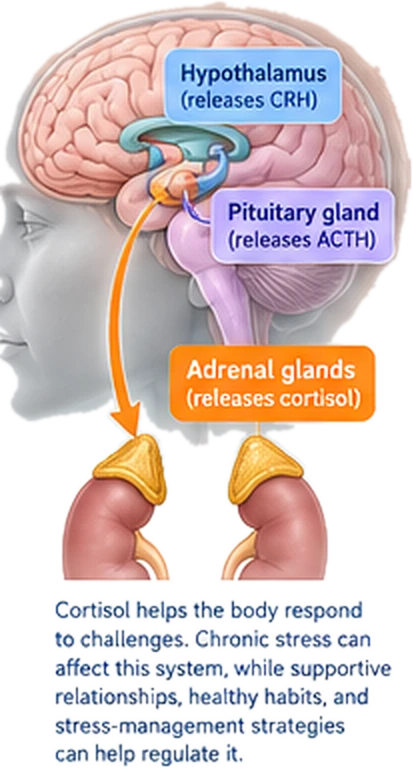
The HPA axis. Simplified educational illustration; labels in the image are in English. The wording in the image is simplified.Describe this illustration
A side view of a head with the brain showing. The hypothalamus and the pituitary gland are labelled near the middle of the brain. An orange arrow runs down to the adrenal glands, which sit on top of the kidneys. A box at the bottom says what cortisol does. CRH and ACTH are the names of the hormones that carry the signals: corticotropin-releasing hormone and adrenocorticotropic hormone.
Labels in the image
Hypothalamus (releases CRH)
Pituitary gland (releases ACTH)
Adrenal glands (releases cortisol)
Cortisol helps the body respond to challenges. Chronic stress can affect this system, while supportive relationships, healthy habits, and stress-management strategies can help regulate it.
The stress axis (HPA)
Select a part to read about it. Use the arrow keys to move between parts, and press Esc to close.
Hypothalamus
A small area deep in the brain. When the brain detects a demand, the hypothalamus sends a hormone signal (called CRH) to the pituitary gland.
Pituitary gland
A small gland at the base of the brain. It answers the signal by releasing another hormone (called ACTH) into the blood, which travels to the adrenal glands.
Adrenal glands
Two small glands that sit on top of the kidneys. They answer the signal by releasing cortisol.
Cortisol
A hormone that helps the body mobilise energy to meet a demand. It is not simply the stress hormone that is always high when you are stressed: patterns vary with the type and length of stress, and between people (Herman et al., 2016).
Feedback loop
Cortisol also signals back to the brain, which normally switches the response off again. This is how the system usually settles. Researchers link harm mainly to long-term or repeated activation rather than to short bursts (Russell & Lightman, 2019).
A simplified picture. Many other brain areas, such as the amygdala and the hippocampus, also shape the stress response. This is education, not medical advice.
What it does. When the brain detects a demand, the hypothalamus signals the pituitary, which signals the adrenal glands to release cortisol. Cortisol helps mobilise energy. Limbic structures such as the amygdala and hippocampus shape this response, and feedback loops normally switch it off again (Herman et al., 2016).
In plain terms. Cortisol is not simply the stress hormone that is always high when you are stressed. Patterns vary with the type and length of stress, genes, early experience, sex and age (Herman et al., 2016).
In an analysis of hair cortisol, people under ongoing stress had higher levels on average, but people with anxiety disorders such as PTSD had lower levels on average. These are associations from pooled studies, and hair cortisol was not consistently linked to mood disorders. Hair cortisol is also affected by age, sex, hair washing and treatment, and contraceptive use, so differences are modest (Stalder et al., 2017).
In a laboratory stress test, some groups showed blunted and others heightened cortisol responses, depending on sex and diagnosis (Zorn et al., 2017).
Why this matters in daily life. Because cortisol responses differ by sex and symptom state (Zorn et al., 2017), a single cortisol result would not tell you whether someone has a condition; this is an inference from those findings. A stress response is a normal reaction and is often protective in the short term. A review of the human stress response links harm mainly to long-term or repeated activation rather than short bursts (Russell & Lightman, 2019). Researchers do not fully agree on which types of stress matter most for health (Epel et al., 2018). One proposed typology separates acute, event-based, daily and chronic stress, which may relate differently to health (Epel et al., 2018).
The autonomic nervous system: activation and recovery
Research-informed
Where it is. The autonomic nervous system is a network of nerves that runs through the body and adjusts things you do not control on purpose, such as heart rate.
What it does. It shifts the body between activation (the sympathetic side) and rest and recovery (the parasympathetic side). Heart rate variability, the small changes in time between heartbeats, is one measure that partly reflects the parasympathetic influence on the heart (Laborde et al., 2017).
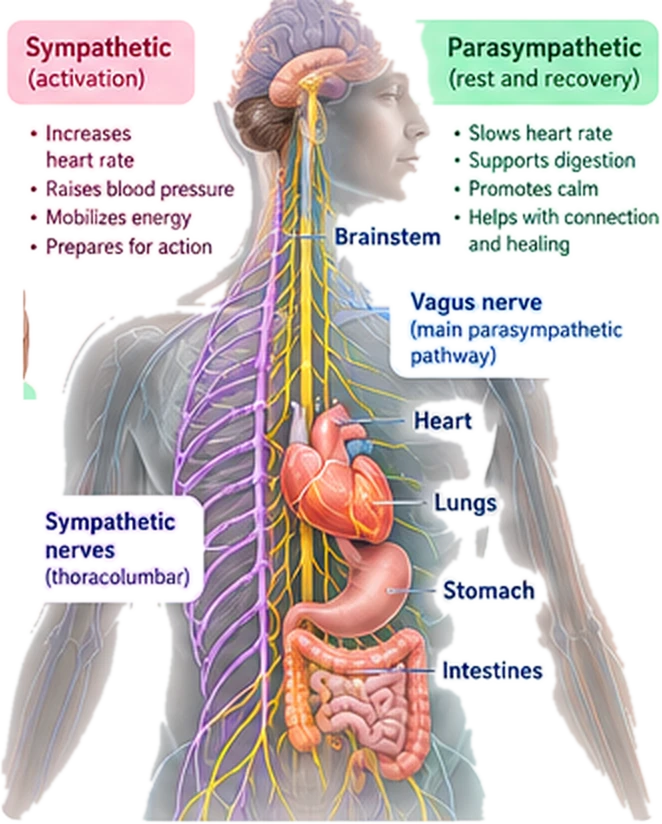
The autonomic nervous system. Simplified educational illustration; labels in the image are in English. The wording in the image is simplified. For example, the vagus nerve is one of several nerve pathways of the parasympathetic side, and this module does not use polyvagal theory.Describe this illustration
A see-through body outline. Nerves run down from the brainstem beside the spine and branch to the heart, lungs, stomach and intestines. A box at the top left names the sympathetic side, which is about activation. A box at the top right names the parasympathetic side, which is about rest and recovery. The vagus nerve and the sympathetic nerves are labelled. The picture also lists short bullet points under each side. One bullet under the parasympathetic side is simplified wording and is not repeated here.
In plain terms. Reviewers of 37 studies, without pooling the results, found that heart rate variability measures most often pointed to lower parasympathetic activity during stress. How to read these measures is debated (Kim et al., 2018; Laborde et al., 2017). Heart rate variability is easy to misinterpret and needs careful measurement, so it is treated as a research marker.
Adults with PTSD show, on average, lower resting heart rate variability and a higher heart rate than healthy controls. These are group differences and cannot be used to diagnose one person (Schneider & Schwerdtfeger, 2020).
What helps? In trials, heart rate variability biofeedback produced small to moderate benefits, largest for anxiety but based on few studies per condition. Effects were larger against no treatment than against active comparison, and no larger than other effective treatments (Lehrer et al., 2020). A systematic review found that slow breathing raised heart rate variability (Zaccaro et al., 2018). These are best seen as complementary to other care. You can try breathing practices in Exercises and Meditation. If slow breathing makes you more anxious, stop.
Meditation and mindfulness practices can sometimes cause unwanted effects such as anxiety or dissociation (Farias et al., 2020). In one 8-week programme (96 people), most had some unwanted effects, usually temporary. About 6 to 14% reported lasting bad effects, linked to heightened arousal or feeling detached (Britton et al., 2021). If a practice increases distress or makes you feel unreal, it is reasonable to stop, slow down, or ask a trauma-informed professional. If you have panic or a trauma history, check with a clinician first.
A theory you may hear about. Polyvagal theory is popular, but its main ideas are disputed in the scientific literature. It is better treated as a contested hypothesis than as established brain science (Grossman, 2023), so this module does not use it. For a wider overview, see the nervous system. That page is separate and may describe the nervous system in other ways, so it is not a source for this module.
Neuroplasticity: the brain changes with learning
Research-informed
What it means. Neuroplasticity is the brain's ability to change with learning and experience. One proposed model is that brain structure grows during skill learning and then partly returns toward baseline (Wenger et al., 2017). Practising a task improves that task, but gains in brain-training games rarely carry over to everyday thinking (Simons et al., 2016).
Why it matters here. Learned reactions, such as a fear response, can be updated by new learning (Craske et al., 2018). How this relates to structural brain change is not settled. The next module, Your Brain Can Learn New Patterns, looks at what the research says about this, including what is still unknown.
Appraisal and emotional memory: what a situation means to you
Research-informed
Appraisal. Appraisal theories propose that emotion begins with how a person evaluates an event. Bodily changes and urges to act follow, and then a conscious feeling and a label (Scherer & Moors, 2019). This is one influential model among several.
A debated alternative. The theory of constructed emotion proposes that the brain builds emotions from predictions and bodily signals instead of triggering fixed emotion circuits (Barrett, 2016). A pooled analysis of 202 laboratory studies found that autonomic body measures did not clearly separate emotion categories and varied within each one. The authors read this as more consistent with constructed emotion than with fixed emotion circuits (Siegel et al., 2018). Both ideas are debated, not established facts.
Emotional memory. Stress can strengthen or weaken what is remembered depending on timing (Shields et al., 2017), and whether cortisol itself explains this is debated (Kim & Kim, 2023). One idea is that recalling a memory briefly makes it open to updating; this is still being tested and has faced challenges (Lee et al., 2017).
Old fears and new learning. When a feared cue is later learned to be safe, this seems to form new learning that competes with the old fear instead of erasing it. Exposure therapy aims to strengthen that new learning across settings (Craske et al., 2018).
Reframing. Reappraisal, changing how you think about a situation, is often effective for managing emotion, but how well it works depends on the person and the situation (McRae & Gross, 2020). Reappraisal is not a cure for anxiety.
Why this matters in daily life. In appraisal theories, which put evaluation first, two people can read the same event differently, and the same person can read it differently on different days. Body sensations on their own may not clearly show which emotion you are having, since a pounding heart can go with different emotions (Siegel et al., 2018).
Explore: the adult brain and body
Research-informed
Open any part to see a short summary. You can stop at any time by closing the panels or leaving the page. These are simplified summaries of the sections above, and those sections list the sources.
Interactive Adult Brain
Research-informed
Four parts of the brain that researchers discuss when they study reactions. None of them works alone, and none is a fear switch. Open a part to read a short summary, and open the last two items to see the HPA axis and the autonomic nervous system as simple steps. This is simplified, and scans show association, not cause. Stop: close the panels or leave the page whenever you like.
Amygdala
A small, almond-shaped cluster of nuclei deep in the temporal lobe, one on each side. It responds to how important, new, uncertain or emotionally charged something is, not only to threat. It works within wider networks (Šimić et al., 2021).
Prefrontal cortex
The front part of the brain’s outer layer. It supports holding goals in mind, switching tasks and holding back impulses, through networks across the brain. It is not a boss that switches emotions off (Friedman & Robbins, 2022).
Hippocampus
A curved structure deep in the temporal lobe, one on each side. It is involved in memory for facts and events. Stress can change how well memory works, depending on timing (Shields et al., 2017). Whether adults make new neurons here is still debated.
Hypothalamus
A small structure deep in the middle of the brain, just above the pituitary gland. It is the first step in the stress hormone pathway (Herman et al., 2016).
HPA axis, in steps
1. The brain detects a demand. 2. The hypothalamus signals the pituitary. 3. The pituitary signals the adrenal glands. 4. The adrenal glands release cortisol. 5. Cortisol feeds back to the brain, which normally switches the response off (Herman et al., 2016).
Autonomic nervous system, in steps
1. A demand or a change in the body is detected. 2. The sympathetic side raises activation, for example a faster heart rate. 3. The parasympathetic side supports rest and recovery. 4. The two sides adjust all the time, and heart rate variability is one research measure that partly reflects this (Laborde et al., 2017).
Try this: Understanding My Reaction
Reflection
This is a reflection, not an assessment. It uses one everyday scene to show how different reactions can make sense. Nothing you read here tells you what is true about you.
Understanding My Reaction
Reflection
Imagine this: someone important to you does not respond to your message. Hours go by. People notice different reactions, and the same person can react differently on different days. Open any reaction below to read about it. None is right or wrong. None points to a specific cause in your past. Reactions tend to reflect your current circumstances, what you expect, what you have learned over time, and how you feel in the moment. This is for your own reflection. It is not a test. Stop: you can close any reaction, use Close all, or leave the page at any time.
Fear of rejection
You might notice a drop in your stomach, thoughts such as ‘they are upset with me’, or an urge to check your phone. The same silence might feel threatening when the person matters a great deal to you, when you are unsure where you stand, or when you are tired or stretched. This is an illustration, not a research finding. A question to hold: what else could explain the silence, and what would you say to a friend in your place? Research behind this idea: appraisal theories propose that emotion starts with how we evaluate an event (Scherer & Moors, 2019). Body sensations alone may not show which emotion you are having (Siegel et al., 2018).
Anger
Anger might show up as heat, a tight jaw, or a wish to send a sharp reply. It may follow a thought such as ‘this is unfair’ or ‘I am being ignored’. Anger is a common emotion, not a flaw, and it can point to something that matters to you. A question to hold: what is this anger telling me matters to me? Research behind this idea: appraisal theories link anger to how we evaluate an event (Scherer & Moors, 2019). In laboratory tasks, short-term stress made it harder to hold several explanations in mind. This was not tested in situations like this one (Shields et al., 2016).
Sadness
Sadness might feel like heaviness, tears, or a wish to withdraw. It might be about this message, or about loneliness, tiredness or other losses that the silence brings to mind. What else is going on for you can colour how you read the silence. If sadness lasts for weeks and affects daily life, see the section on getting support below, and our page on depression. A question to hold: what do I need right now, and from whom? Research behind this idea: appraisal models treat evaluation as the starting point (Scherer & Moors, 2019).
Worry
Worry might sound like ‘what if something is wrong?’ or ‘what did I say?’, with thoughts running ahead of the facts. If worry feels constant or hard to control, see our page on anxiety. A question to hold: what do I know for certain, and what am I guessing? Research behind this idea: reappraisal, which means changing how you think about a situation, is often effective for managing emotion. How well it works depends on the person and the situation. It is a tool, not a cure (McRae & Gross, 2020).
Neutral interpretation
Some people simply think ‘they are probably busy’ and carry on with their day. This is not the right way to react, and it is not a goal you have to reach. It may reflect circumstances, for example a person who often replies late, so the silence does not carry much meaning. It may also reflect a calmer day. If you rarely read situations this way, that does not mean something is wrong with you. Research behind this idea: in laboratory tasks, short-term stress tended to reduce mental flexibility. Whether this affects how you read a message was not tested (Shields et al., 2016).
Explore the stress response
Research-informed
Stress involves several layers at once. This explorer lets you open each layer and see what kind of research sits behind it.
Stress Response Explorer
Research-informed
Stress involves the body, attention, memory and meaning all at once. Open any layer to see what research suggests. Each layer ends with a line saying what the evidence is based on. You can open them in any order. Stop: close the panels or leave the page whenever you like.
The nerves: activation and recovery
The autonomic nervous system shifts the body between activation and recovery. Reviewers of 37 studies, without pooling the results, found that heart rate variability measures most often pointed to lower parasympathetic activity during stress. This is a research marker, and it is easy to misinterpret (Kim et al., 2018; Laborde et al., 2017). Based on: a review of 37 studies without pooled results.
The hormones: the HPA axis
The hypothalamus signals the pituitary, which signals the adrenal glands to release cortisol, which helps mobilise energy. Feedback loops normally switch the response off (Herman et al., 2016). Cortisol patterns vary between people and types of stress. Because cortisol responses differ by sex and symptom state, a single cortisol result would not tell you whether someone has a condition (an inference from Zorn et al., 2017). Based on: a review of the pathway, and laboratory and group studies of cortisol.
Attention and thinking
In laboratory experiments, short-term stress tended to impair working memory and mental flexibility, with effects that varied and differed by sex. Participants were mostly healthy volunteers, and the effects were short-term (Shields et al., 2016). Based on: pooled laboratory studies.
Memory
Stress at the time of learning or recall usually made memory worse, while stress shortly after learning often helped it, depending on timing, setting and material (Shields et al., 2017). Based on: pooled laboratory studies.
How you read the situation
Appraisal theories propose that the evaluation of an event comes before body changes, urges and the feeling you name (Scherer & Moors, 2019). This is one model among several, and the theory of constructed emotion offers a debated alternative (Barrett, 2016). Based on: theories that are debated.
Short bursts and long stretches
A stress response is a normal reaction and is often protective in the short term. A review of the human stress response links harm mainly to long-term or repeated activation rather than short bursts (Russell & Lightman, 2019). Researchers do not fully agree on which types of stress matter most for health, and one proposed typology separates acute, event-based, daily and chronic stress (Epel et al., 2018). Based on: a review, and one proposed way of sorting stress types.
Slowing down: breathing and biofeedback
In trials, heart rate variability biofeedback produced small to moderate benefits, largest for anxiety but based on few studies per condition. Effects were larger against no treatment than against active comparison (Lehrer et al., 2020). A systematic review found that slow breathing raised heart rate variability (Zaccaro et al., 2018). These are best seen as complementary. Try gentle practices in Exercises. If slow breathing makes you more anxious, stop. Based on: trials and one systematic review.
What the research does and does not show
Research-informed
Association, causation and theory
Research-informed
Brain scans show which regions are active together. On their own they show association rather than cause. Many brain-imaging studies use small samples, and large studies show that small samples can give unreliable results for links between brain and behaviour (Marek et al., 2022). The structural differences reported in PTSD and depression are small group averages, and they cannot show whether stress caused them (Logue et al., 2018; Schmaal et al., 2016).
Whether adults make new neurons in the hippocampus is still debated, so no claim about new neurons is made here.
Laboratory studies of stress can test cause and effect, but they use short stressors, and the studies of thinking tasks included healthy volunteers (Shields et al., 2016; Shields et al., 2017).
Ideas such as the two-system proposal, appraisal theory and constructed emotion are theories. They are debated, and each may capture only part of the picture (LeDoux & Pine, 2016; Scherer & Moors, 2019; Barrett, 2016). Polyvagal theory is contested, so it is not used here (Grossman, 2023).
Cortisol responses and heart rate variability differ between groups on average, but the differences are modest and overlap, so they are research measures rather than tests for an individual (Zorn et al., 2017; Schneider & Schwerdtfeger, 2020; Laborde et al., 2017).
Group findings cannot be used to say what is wrong with an individual reader. Much of the work behind circuit models comes from animals, and how well it carries over to people is still being worked out (Fox & Shackman, 2019; Kim & Kim, 2023).
If your reactions get in the way of daily life, such as your sleep, work, health or relationships, or if distress lasts, it is a good time to talk with a licensed professional. You do not need to be in a crisis to ask. See How to choose a therapist and therapy types. If you are worried about trauma, see trauma and PTSD.
If you are in crisis or thinking about suicide, call or text 988 in the United States or Canada (chat in the US at 988lifeline.org). In the UK or Ireland, call Samaritans on 116 123. In Australia, call Lifeline on 13 11 14. In New Zealand, call or text 1737. These lines are free to call from most phones and open 24 hours a day. Elsewhere, find a local helpline at findahelpline.com. If someone is in immediate danger, call your local emergency number.
If you are in crisis or thinking about suicide, call or text 988 in the United States or Canada (chat in the US at 988lifeline.org). In the UK or Ireland, call Samaritans on 116 123. In Australia, call Lifeline on 13 11 14. In New Zealand, call or text 1737. These lines are free to call from most phones and open 24 hours a day. Elsewhere, find a local helpline at findahelpline.com. If someone is in immediate danger, call your local emergency number.
Sources and further reading
Barrett, L. F. (2016). The theory of constructed emotion: An active inference account of interoception and categorization. Social Cognitive and Affective Neuroscience, nsw154. Source The theory of constructed emotion, a debated theory.
Boldrini, M., Fulmore, C. A., Tartt, A. N., Simeon, L. R., Pavlova, I., Poposka, V., Rosoklija, G. B., Stankov, A., Arango, V., Dwork, A. J., Hen, R., & Mann, J. J. (2018). Human hippocampal neurogenesis persists throughout aging. Cell Stem Cell, 22(4), 589–599.e5. Source Adult hippocampal neurogenesis reported in a post-mortem study; one side of a continuing debate.
Britton, W. B., Lindahl, J. R., Cooper, D. J., Canby, N. K., & Palitsky, R. (2021). Defining and Measuring Meditation-Related Adverse Effects in Mindfulness-Based Programs. Clinical Psychological Science, 9(6), 1185-1204. Source One 8-week programme (96 people): most had some unwanted effects, usually temporary; about 6 to 14% reported lasting bad effects.
Craske, M. G., Hermans, D., & Vervliet, B. (2018). State-of-the-art and future directions for extinction as a translational model for fear and anxiety. Philosophical Transactions of the Royal Society B: Biological Sciences, 373(1742), 20170025. Source New safety learning competes with, but does not erase, old fear.
Dumitru, I., Paterlini, M., Zamboni, M., Ziegenhain, C., Giatrellis, S., Saghaleyni, R., Björklund, Å., Alkass, K., Tata, M., Druid, H., Sandberg, R., & Frisén, J. (2025). Identification of proliferating neural progenitors in the adult human hippocampus. Science, 389(6755), 58–63. Source Proliferating progenitor cells identified in adult human tissue.
Epel, E. S., Crosswell, A. D., Mayer, S. E., Prather, A. A., Slavich, G. M., Puterman, E., & Mendes, W. B. (2018). More than a feeling: A unified view of stress measurement for population science. Frontiers in Neuroendocrinology, 49, 146-169. Source Little agreement on which types of stress matter most for health; one proposed typology of stress.
Farias, M., Maraldi, E., Wallenkampf, K. C., & Lucchetti, G. (2020). Adverse events in meditation practices and meditation‐based therapies: a systematic review. Acta Psychiatrica Scandinavica, 142(5), 374-393. Source Meditation can cause unwanted effects in some people.
Fox, A. S., & Shackman, A. J. (2019). The central extended amygdala in fear and anxiety: Closing the gap between mechanistic and neuroimaging research. Neuroscience Letters, 693, 58–67. Source The central amygdala and a neighbouring area help organise defensive responses; human relevance still being worked out.
Franjic, D., Skarica, M., Ma, S., Arellano, J. I., Tebbenkamp, A. T. N., Choi, J., Xu, C., Li, Q., Morozov, Y. M., Andrijevic, D., Vrselja, Z., Spajic, A., Santpere, G., Li, M., Zhang, S., Liu, Y., Spurrier, J., Zhang, L., Gudelj, I., … Sestan, N. (2022). Transcriptomic taxonomy and neurogenic trajectories of adult human, macaque, and pig hippocampal and entorhinal cells. Neuron, 110(3), 452–469.e14. Source No robust neurogenic signature in adult human tissue; DCX is not a clean marker.
Friedman, N. P., & Robbins, T. W. (2022). The role of prefrontal cortex in cognitive control and executive function. Neuropsychopharmacology, 47(1), 72–89. Source Prefrontal networks and cognitive control.
Fullana, M. A., Harrison, B. J., Soriano-Mas, C., Vervliet, B., Cardoner, N., Àvila-Parcet, A., & Radua, J. (2016). Neural signatures of human fear conditioning: An updated and extended meta-analysis of fMRI studies. Molecular Psychiatry, 21(4), 500–508. Source Fear learning activates a network of regions together (association).
Grossman, P. (2023). Fundamental challenges and likely refutations of the five basic premises of the polyvagal theory. Biological Psychology, 180, 108589. Source Polyvagal theory is disputed and is treated here as a contested hypothesis.
Herman, J. P., McKlveen, J. M., Ghosal, S., Kopp, B., Wulsin, A., Makinson, R., Scheimann, J., & Myers, B. (2016). Regulation of the hypothalamic-pituitary-adrenocortical stress response. Comprehensive Physiology, 603–621. Source How the HPA axis works (hypothalamus, pituitary, adrenal) and why chronic-stress patterns vary.
Hiser, J., & Koenigs, M. (2018). The multifaceted role of the ventromedial prefrontal cortex in emotion, decision making, social cognition, and psychopathology. Biological Psychiatry, 83(8), 638–647. Source The ventromedial prefrontal cortex in decisions, emotion regulation and social understanding.
Kempermann, G., Gage, F. H., Aigner, L., Song, H., Curtis, M. A., Thuret, S., Kuhn, H. G., Jessberger, S., Frankland, P. W., Cameron, H. A., Gould, E., Hen, R., Abrous, D. N., Toni, N., Schinder, A. F., Zhao, X., Lucassen, P. J., & Frisén, J. (2018). Human adult neurogenesis: Evidence and remaining questions. Cell Stem Cell, 23(1), 25–30. Source Review of the state of the neurogenesis debate and remaining questions.
Kim, E. J., & Kim, J. J. (2023). Neurocognitive effects of stress: A metaparadigm perspective. Molecular Psychiatry, 28(7), 2750–2763. Source Stress, hippocampal plasticity and emotional learning; the role of cortisol is debated.
Kim, H.-G., Cheon, E.-J., Bai, D.-S., Lee, Y. H., & Koo, B.-H. (2018). Stress and heart rate variability: A meta-analysis and review of the literature. Psychiatry Investigation, 15(3), 235–245. Source A review of 37 studies without pooled results: heart rate variability measures most often pointed to lower parasympathetic activity under stress; interpretation debated.
Laborde, S., Mosley, E., & Thayer, J. F. (2017). Heart rate variability and cardiac vagal tone in psychophysiological research – recommendations for experiment planning, data analysis, and data reporting. Frontiers in Psychology, 8. Source Heart rate variability is easy to misinterpret and needs careful measurement.
LeDoux, J. E., & Pine, D. S. (2016). Using neuroscience to help understand fear and anxiety: A two-system framework. American Journal of Psychiatry, 173(11), 1083–1093. Source Two-system proposal about quick defence responses and the feeling of fear (a proposal, not a settled fact).
Lee, J. L., Nader, K., & Schiller, D. (2017). An update on memory reconsolidation updating. Trends in Cognitive Sciences, 21(7), 531–545. Source Recalled memories can be updated; clinical use is early.
Lehrer, P., Kaur, K., Sharma, A., Shah, K., Huseby, R., Bhavsar, J., Sgobba, P., & Zhang, Y. (2020). Heart rate variability biofeedback improves emotional and physical health and performance: A systematic review and meta analysis. Applied Psychophysiology and Biofeedback, 45(3), 109–129. Source Heart rate variability biofeedback: small-to-moderate effects, larger against no treatment than active comparison, complementary.
Logue, M. W., van Rooij, S. J., Dennis, E. L., Davis, S. L., Hayes, J. P., Stevens, J. S., Densmore, M., Haswell, C. C., Ipser, J., Koch, S. B., Korgaonkar, M., Lebois, L. A., Peverill, M., Baker, J. T., Boedhoe, P. S., Frijling, J. L., Gruber, S. A., Harpaz-Rotem, I., Jahanshad, N., .. Morey, R. A. (2018). Smaller hippocampal volume in posttraumatic stress disorder: A multisite ENIGMA-PGC study: Subcortical volumetry results from posttraumatic stress disorder consortia. Biological Psychiatry, 83(3), 244–253. Source Slightly smaller hippocampal volume in PTSD; cannot show cause.
Marek, S., Tervo-Clemmens, B., Calabro, F. J., Montez, D. F., Kay, B. P., Hatoum, A. S., Donohue, M. R., Foran, W., Miller, R. L., Hendrickson, T. J., Malone, S. M., Kandala, S., Feczko, E., Miranda-Dominguez, O., Graham, A. M., Earl, E. A., Perrone, A. J., Cordova, M., Doyle, O., … Dosenbach, N. U. F. (2022). Reproducible brain-wide association studies require thousands of individuals. Nature, 603(7902), 654–660. Source Brain-imaging studies with small samples can give unreliable results for brain-behaviour links.
McRae, K., & Gross, J. J. (2020). Emotion regulation. Emotion, 20(1), 1–9. Source Reappraisal is often effective, depending on the person and context.
Morawetz, C., Bode, S., Derntl, B., & Heekeren, H. R. (2017). The effect of strategies, goals and stimulus material on the neural mechanisms of emotion regulation: A meta-analysis of fMRI studies. Neuroscience & Biobehavioral Reviews, 72, 111–128. Source Left ventrolateral prefrontal cortex is often active during emotion regulation with several strategies, together with other regions (association).
Moreno-Jiménez, E. P., Flor-García, M., Terreros-Roncal, J., Rábano, A., Cafini, F., Pallas-Bazarra, N., Ávila, J., & Llorens-Martín, M. (2019). Adult hippocampal neurogenesis is abundant in neurologically healthy subjects and drops sharply in patients with Alzheimer’s disease. Nature Medicine, 25(4), 554–560. Source Immature neurons reported in older adult human hippocampus.
Picó-Pérez, M., Radua, J., Steward, T., Menchón, J. M., & Soriano-Mas, C. (2017). Emotion regulation in mood and anxiety disorders: A meta-analysis of fMRI cognitive reappraisal studies. Progress in Neuro-Psychopharmacology and Biological Psychiatry, 79, 96–104. Source Regulation networks less engaged during reappraisal tasks in mood and anxiety disorders (association).
Ressler, K. J., Berretta, S., Bolshakov, V. Y., Rosso, I. M., Meloni, E. G., Rauch, S. L., & Carlezon, W. A. (2022). Post-traumatic stress disorder: Clinical and translational neuroscience from cells to circuits. Nature Reviews Neurology, 18(5), 273–288. Source PTSD seen partly as dysregulated fear processing in an amygdala, hippocampus and medial prefrontal circuit.
Russell, G., & Lightman, S. (2019). The human stress response. Nature Reviews Endocrinology, 15(9), 525-534. Source Stress responses are normal and often protective in the short term; context decides.
Scherer, K. R., & Moors, A. (2019). The emotion process: Event appraisal and component differentiation. Annual Review of Psychology, 70(1), 719–745. Source Appraisal theory of the emotion process.
Schmaal, L., Veltman, D. J., van Erp, T. G. M., Sämann, P. G., Frodl, T., Jahanshad, N., Loehrer, E., Tiemeier, H., Hofman, A., Niessen, W. J., Vernooij, M. W., Ikram, M. A., Wittfeld, K., Grabe, H. J., Block, A., Hegenscheid, K., Völzke, H., Hoehn, D., Czisch, M., .. Hibar, D. P. (2016). Subcortical brain alterations in major depressive disorder: Findings from the ENIGMA major depressive disorder working group. Molecular Psychiatry, 21(6), 806–812. Source Slightly smaller hippocampal volume in recurrent depression; cannot show cause.
Schneider, M., & Schwerdtfeger, A. (2020). Autonomic dysfunction in posttraumatic stress disorder indexed by heart rate variability: A meta-analysis. Psychological Medicine, 50(12), 1937–1948. Source Lower heart rate variability and higher heart rate in PTSD on average (group difference).
Shields, G. S., Sazma, M. A., & Yonelinas, A. P. (2016). The effects of acute stress on core executive functions: A meta-analysis and comparison with cortisol. Neuroscience & Biobehavioral Reviews, 68, 651–668. Source Short-term stress impaired working memory and flexibility in laboratory studies.
Shields, G. S., Sazma, M. A., McCullough, A. M., & Yonelinas, A. P. (2017). The effects of acute stress on episodic memory: A meta-analysis and integrative review. Psychological Bulletin, 143(6), 636–675. Source Timing of stress and episodic memory in laboratory experiments.
Siegel, E. H., Sands, M. K., Van den Noortgate, W., Condon, P., Chang, Y., Dy, J., Quigley, K. S., & Barrett, L. F. (2018). Emotion fingerprints or emotion populations? A meta-analytic investigation of autonomic features of emotion categories. Psychological Bulletin, 144(4), 343–393. Source Bodily patterns did not cleanly separate emotion categories; interpretation is contested.
Simons, D. J., Boot, W. R., Charness, N., Gathercole, S. E., Chabris, C. F., Hambrick, D. Z., & Stine-Morrow, E. A. L. (2016). Do “Brain-training” programs work? Psychological Science in the Public Interest, 17(3), 103–186. Source Brain-training improves trained tasks far more reliably than everyday thinking.
Sorrells, S. F., Paredes, M. F., Cebrian-Silla, A., Sandoval, K., Qi, D., Kelley, K. W., James, D., Mayer, S., Chang, J., Auguste, K. I., Chang, E. F., Gutierrez, A. J., Kriegstein, A. R., Mathern, G. W., Oldham, M. C., Huang, E. J., Garcia-Verdugo, J. M., Yang, Z., & Alvarez-Buylla, A. (2018). Human hippocampal neurogenesis drops sharply in children to undetectable levels in adults. Nature, 555(7696), 377–381. Source Another post-mortem study found it extremely rare, so the question is debated.
Stalder, T., Steudte-Schmiedgen, S., Alexander, N., Klucken, T., Vater, A., Wichmann, S., Kirschbaum, C., & Miller, R. (2017). Stress-related and basic determinants of hair cortisol in humans: A meta-analysis. Psychoneuroendocrinology, 77, 261–274. Source Hair cortisol is higher with ongoing stress and lower in anxiety disorders such as PTSD; also affected by age, sex, hair washing, treatment and contraceptive use.
Tobin, M. K., Musaraca, K., Disouky, A., Shetti, A., Bheri, A., Honer, W. G., Kim, N., Dawe, R. J., Bennett, D. A., Arfanakis, K., & Lazarov, O. (2019). Human hippocampal neurogenesis persists in aged adults and Alzheimer’s disease patients. Cell Stem Cell, 24(6), 974–982.e3. Source Neural progenitors and immature neurons reported in aged human hippocampus, numbers varying greatly between people.
Wenger, E., Brozzoli, C., Lindenberger, U., & Lövdén, M. (2017). Expansion and renormalization of human brain structure during skill acquisition. Trends in Cognitive Sciences, 21(12), 930–939. Source Adult brains change with learning, and structural change may rise then partly return.
Zaccaro, A., Piarulli, A., Laurino, M., Garbella, E., Menicucci, D., Neri, B., & Gemignani, A. (2018). How breath-control can change your life: A systematic review on psycho-physiological correlates of slow breathing. Frontiers in Human Neuroscience, 12, 353. Source Slow breathing raised heart rate variability in a systematic review.
Zorn, J. V., Schür, R. R., Boks, M. P., Kahn, R. S., Joëls, M., & Vinkers, C. H. (2017). Cortisol stress reactivity across psychiatric disorders: A systematic review and meta-analysis. Psychoneuroendocrinology, 77, 25–36. Source Cortisol responses to a laboratory stress test differ by sex and diagnosis.
Šimić, G., Tkalčić, M., Vukić, V., Mulc, D., Španić, E., Šagud, M., Olucha-Bordonau, F. E., Vukšić, M., & Hof, P. R. (2021). Understanding emotions: Origins and roles of the amygdala. Biomolecules, 11(6), 823. Source The amygdala is a cluster of nuclei in the temporal lobe; it evaluates input, takes part in learning and body regulation, and responds to salience and uncertainty.
Within Your Light provides psychoeducation. This page is for educational purposes only and is not medical advice, diagnosis, or treatment. Please talk with a licensed professional about your own health. If you are in crisis, call or text 988 in the United States, or use your local emergency number or findahelpline.com.