People are not fixed by their past or by how they react today. Research suggests that, on average, some patterns such as attachment anxiety and avoidance decline gradually across adulthood. This module looks at what is known, what is still debated, and what tends to help. It does not promise results or tell you that you need to change.
About 13 min read
A note on safety. This page explains research about change and about therapies. It is education, not therapy, and it is not medical advice or a diagnosis.
You can stop at any time. Skip any question that feels like too much.
Thinking about change can bring up hope, but also pressure or sadness. You do not have to change anything on any timetable.
If distress is affecting your sleep, work, health or relationships, a licensed professional can help.
Nothing you write in the reflection on this page is sent anywhere.
What this module is about
Research-informed
A pattern is a way of reacting or relating that has built up over time. Patterns are a description of how we tend to respond. They are not a verdict on who we are. Early experience is only weakly linked to adult attachment (Fraley & Roisman, 2019). Research supports the idea that learning and experience can change how people respond across adulthood. How much and how fast differs for everyone and is hard to predict.
In three small US cohort studies (628 people in total, born in the mid-20th century), attachment anxiety and avoidance declined on average with age, and people in relationships tended to score lower on both. These cohorts may differ from younger generations. These are group averages, not a prediction for any one person (Chopik et al., 2019).
Brain-training games improve performance on the trained tasks, with little evidence of transfer to everyday thinking, although many studies had design weaknesses (Simons et al., 2016). Studies of skill learning suggest brain structure may change; one proposed model is growth followed by partial return toward baseline (Wenger et al., 2017).
The research in this module looks at several routes people use to change, including repeated learning, supportive relationships, therapy and surroundings. The strength of evidence differs for each.
Different therapies have very different amounts of evidence, and the evidence differs by condition.
Please note: Not every pattern needs changing, and not everything you find hard comes from the past. Wanting to understand yourself better is enough of a reason to read this.
How the adult brain changes
Research-informed
What the research shows. Neuroplasticity means that the brain changes with learning and experience. Computer-based brain-training games improve performance on the trained tasks, with little evidence of transfer to everyday thinking skills, although many studies had design weaknesses (Simons et al., 2016).
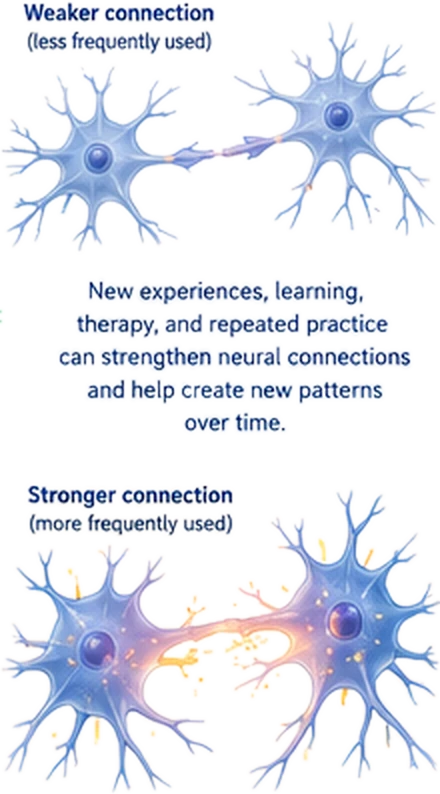
Neuroplasticity: a weaker and a stronger connection. Simplified educational illustration; labels in the image are in English. The wording in the image is simplified. The research on how the adult brain changes is more mixed, as the text above explains.Describe this illustration
Two drawings of nerve cells, one above the other. In the upper drawing the link between two cells is thin and is labelled as less frequently used. In the lower drawing the link is thicker and brighter and is labelled as more frequently used. A box between the drawings holds a sentence about new experiences and practice.
Labels in the image
Weaker connection (less frequently used)
Stronger connection (more frequently used)
New experiences, learning, therapy, and repeated practice can strengthen neural connections and help create new patterns over time.
A proposed model. Studies of skill learning suggest that brain structure may first grow and then partly return toward its starting point. This is a proposed model and not a rule (Wenger et al., 2017).
New brain cells: still debated. Whether adults make new neurons in the hippocampus is still debated. Studies from 2018 onward disagree. Some find immature neurons or progenitor cells in adult and even older human brains, with large differences between people. Others find almost none, and the markers used are themselves contested (Dumitru et al., 2025; Franjic et al., 2022; Kempermann et al., 2018; Sorrells et al., 2018; Tobin et al., 2019). Nothing here shows you can grow new neurons on purpose, so this module makes no such claim.
Scans before and after therapy. Analyses of brain scans before and after psychotherapy for depression or anxiety found reduced activity in some emotion-related regions. This is an association, and its meaning is still debated. The simple idea of the prefrontal cortex going up and emotion regions going down may be too simple (Marwood et al., 2018). The studies do not show that therapy physically repairs a particular region.
Many brain-imaging studies use small samples, and large studies show that small samples can give unreliable results for links between brain and behaviour (Marek et al., 2022).
Exercise. In trials, aerobic exercise did not clearly increase overall hippocampal size, but it may help prevent the usual shrinking with age, especially on the left side. This is a finding about brain structure, not about mental health (Firth et al., 2018).
Where the evidence is limited: Much of the work on how the brain changes is based on group averages, small samples, or animal studies. It cannot tell you how fast or how much your own brain might change.
What tends to help
Research-informed
No single route works for everyone. These are some routes researchers have studied. Each section says how firmly that route is supported, and some rest only on associations.
Repeated learning and practice
Research-informed
When a feared cue is learned to be safe, this seems to create new learning that competes with the old fear, instead of erasing it. Exposure therapy aims to strengthen this new learning across different settings (Craske et al., 2018). In fear-extinction research, practising across different settings helps the new learning carry over. Old reactions can return at times, which is common in this research and does not mean you have failed. That last point is reassurance rather than a research finding.
Supportive relationships
Research-informed
In a review of 22 cohort studies of young people exposed to childhood adversity, some family factors (such as family cohesion) and social support were linked to better mental health. This is an association from observational studies (Fritz et al., 2018). In therapy, attachment insecurity is linked to a slightly weaker bond with a therapist; the link is small (Notsu et al., 2024).
Regulation skills
Research-informed
Heart rate variability biofeedback produced small to moderate benefits in trials, largest for anxiety but based on few studies per condition (Lehrer et al., 2020). A systematic review found that slow breathing raised heart rate variability (Zaccaro et al., 2018). These are best seen as complementary. Try gentle practices in Exercises and Meditation. If a practice makes you feel worse, you can stop.
Cognitive restructuring
Research-informed
Cognitive restructuring means examining and revising unhelpful thoughts. In trials with adults with depression, it helped about as much as behavioural activation or full CBT (Ciharova et al., 2021). Researchers do not yet know which single part of CBT drives the benefit (Cuijpers et al., 2019). So changing thoughts is helpful, but it is not shown to be the only route. Reframing is often effective, but how well it works depends on the person and the situation (McRae & Gross, 2020).
Values-based action
Research-informed
Acting on your values is central to Acceptance and Commitment Therapy (see below). We found no direct research on values-based action on its own, so this module does not make claims about it.
Your surroundings
Research-informed
In workplaces, leader support for employees' autonomy was linked to better well-being and less distress, and the links did not differ by the country of the sample (Slemp et al., 2018). In schools, students whose teachers support their choice and connection tend to report better well-being (Howard et al., 2025). These are correlations from school and work settings. They do not show that changing your surroundings would change your well-being.
Therapies and their evidence
Research-informed
The evidence is not equal. Therapies have been studied for very different lengths of time, in different conditions, and with different study quality. A therapy that works well for one condition may have little evidence for another. The folds below say what the research supports, and for which conditions.
Cognitive behavioural therapy (CBT)
Research-informed
CBT is the most studied psychological treatment, especially for depression (Cuijpers et al., 2023; Fordham et al., 2021). In trials for depression, it clearly beat waitlist or usual care, and it performed about as well as other psychotherapies (Cuijpers et al., 2023; Cuijpers et al., 2021). Large benefits against waitlists shrink against other active therapies, where differences are small or absent. Some researchers argue that CBT is often called the gold standard more confidently than the evidence allows (Leichsenring & Steinert, 2017).
For anxiety-related conditions, CBT helped many people in placebo-controlled trials. Effects were larger for obsessive-compulsive disorder and generalised anxiety, and smaller for PTSD, social anxiety and panic (Carpenter et al., 2018).
A review of 494 reviews found a modest average benefit to quality of life across many conditions, a small average gain. Most of the reviews were of lower quality, and few covered trials from Asia, South America or Africa (Fordham et al., 2021). The effect is modest, so CBT should not be presented as a cure-all.
Acceptance and Commitment Therapy (ACT)
Research-informed
ACT improved pain-related outcomes in trials of people with chronic pain. Effects were larger against a waiting list or usual care than against other treatments (Ma et al., 2023; Gloster et al., 2020; Hughes et al., 2017). For depression, trials of third-wave therapies as a group (a label under which ACT is often placed) found results similar to other therapies (Cuijpers et al., 2021).
The sources used here cover chronic pain and, indirectly, depression. This module does not claim ACT is better than other therapies.
Compassion-focused approaches
Research-informed
Compassion-based programs improved self-compassion, depression, anxiety, distress and well-being by moderate amounts in a pooled analysis of 21 trials, but the studies were mostly small and used self-report (Kirby et al., 2017). For Compassion Focused Therapy specifically, one review reports promise, especially in group formats (Craig et al., 2020).
Compassion Focused Therapy still needs more randomised trials and a standard treatment manual (Craig et al., 2020).
Schema therapy
Research-informed
Most of the research on schema therapy is in people diagnosed with personality disorders by clinicians. This does not mean the approach is only for them. Nothing here can tell you whether you have such a condition.
In a large trial in 495 people with borderline personality disorder, schema therapy (especially combined individual and group sessions) outperformed treatment as usual (Arntz et al., 2022). A Cochrane review found that psychological therapies reduced symptom severity compared with usual care (moderate-quality evidence), with most trials of dialectical behaviour therapy or mentalization-based treatment; evidence for other outcomes was lower quality (Storebø et al., 2020).
For other conditions, the evidence for schema therapy is still sparse (Taylor et al., 2016).
EMDR (eye movement desensitisation and reprocessing)
Research-informed
Trauma-focused CBT and EMDR have the most trial support among psychological therapies for PTSD in adults. The evidence is of moderate-to-low quality (Lewis et al., 2020; Mavranezouli et al., 2020). Reviewers also found signs of publication bias in EMDR studies, which means positive results may be more likely to be published. They found large differences between studies too (Cuijpers et al., 2020).
Trials suggest EMDR may help with PTSD, at least in the short term. Only 4 of 27 studies had low risk of bias, and EMDR's advantage over other therapies disappeared in those studies (Cuijpers et al., 2020). How much the eye movements themselves add is not settled, and research on how EMDR works is still developing (Landin-Romero et al., 2018).
EMDR has established clinical uses for trauma-related symptoms. Evidence for other conditions is insufficient (Cuijpers et al., 2020). It is not a therapy for everything.
Treatment guidelines are updated over time and may differ in how they rate EMDR. In a 2021 review of 14 PTSD guidelines (published 2004 to 2020, several now out of date), all but one recommended cognitive behavioural therapy as a first-line psychological treatment (Martin et al., 2021). For current national guidance, ask a licensed clinician.
Attachment-informed approaches
Research-informed
People with more secure attachment tend to do somewhat better in therapy on average, and gains in attachment security may go along with better outcomes. This is an association, and group averages do not tell you how you would respond (Levy et al., 2018). Attachment insecurity is also linked to a slightly weaker bond with a therapist; the link is small (Notsu et al., 2024).
In one trial with 129 adolescents who were suicidal, attachment-based family therapy did not do better than another family-enhanced supportive therapy, and both groups improved substantially. The authors note this could reflect shared treatment elements or regression to the mean, because there was no untreated comparison (Diamond et al., 2019).
Emotionally Focused Therapy for couples is an attachment-based approach. A review by the therapy's developer and a colleague reports that it meets guidelines for an evidence-based couple therapy (Wiebe & Johnson, 2016); independent reviews would add confidence.
Body-oriented (somatic) approaches
Research-informed
These approaches propose that noticing and regulating body sensations may help. This is a theory.
Somatic Experiencing has limited evidence. In one small trial, people who had 15 weekly sessions improved on PTSD symptoms compared with a waitlist, and the authors say more research is needed (Brom et al., 2017). A review of the wider evidence found preliminary positive effects and mixed study quality (Kuhfuß et al., 2021).
A systematic review and meta-analysis of body- and movement-oriented treatments for PTSD found benefits on average, but very large differences between studies. Almost all included studies had some concerns or high risk of bias. The treatments were many kinds, not one therapy (van de Kamp et al., 2023; van de Kamp et al., 2019). These approaches should not be presented as proven, or as better than trauma-focused therapies.
Sensorimotor psychotherapy is not covered because we found no trial evidence to cite.
This reflection invites you to look at how you already cope, without judging it. It is private, optional, and not an assessment.
Helpful coping strategies: a five-question reflection
Reflection
This is a reflection, not a test or an assessment. There are no right answers. It asks you to look at how you already cope, without judging it. Answers stay on this device. You can pause at any time.
What the research does and does not show
Research-informed
Association, causation and theory
Research-informed
Most brain-scan findings about change show association, not cause. Many imaging studies use small samples, and large studies show that small samples can give unreliable results (Marek et al., 2022). Whether adults make new neurons is still debated, so no claim about new brain cells is made here (Kempermann et al., 2018; Dumitru et al., 2025; Franjic et al., 2022).
Trials of therapies can show that a treatment helps on average, compared with waitlists, usual care or other treatments. Waitlist comparisons can make a treatment look better than it would against care as usual or another active treatment; in one analysis of depression treatment, effects against a waitlist were about twice as large as against usual care (Ciharova et al., 2021). Results are averages, and they do not say how any one person will respond (Cuijpers et al., 2023).
Attachment and therapy outcome are linked in these studies, but the design cannot show that attachment change causes better outcomes (Levy et al., 2018). Most reviews of CBT were lower quality, and few of the reviews included trials from Asia, South America or Africa (Fordham et al., 2021).
Somatic Experiencing rests on a few small trials. EMDR's edge over other trauma therapies is uncertain. Compassion-based programs rest on small trials (Brom et al., 2017; Cuijpers et al., 2020; Kirby et al., 2017).
A closing message
Reflection
Understanding yourself is not about finding everything that is wrong with you. It is about learning how you function, recognising what you need, and building knowledge and skills to live with more awareness, connection and authenticity.
Experiences influence us, but they do not have to decide every future response. Saying no does not automatically mean rejecting other people. Asking for help can fit with being independent. Your emotional reactions can deserve curiosity before self-judgment. Growth can involve understanding the psychological and biological processes behind how you think, feel and act.
This message is a reflection, in the spirit of this section. It is not a research finding.
When to ask for help
Research-informed
If distress is affecting your daily life, such as your sleep, work, health or relationships, or if it has lasted for weeks, it is a good time to talk with a licensed professional. You do not need to wait for a crisis. A professional can help you choose an approach that fits your situation.
If you are in crisis or thinking about suicide, call or text 988 in the United States or Canada (chat in the US at 988lifeline.org). In the UK or Ireland, call Samaritans on 116 123. In Australia, call Lifeline on 13 11 14. In New Zealand, call or text 1737. These lines are free to call from most phones and open 24 hours a day. Elsewhere, find a local helpline at findahelpline.com. If someone is in immediate danger, call your local emergency number.
If you are in crisis or thinking about suicide, call or text 988 in the United States or Canada (chat in the US at 988lifeline.org). In the UK or Ireland, call Samaritans on 116 123. In Australia, call Lifeline on 13 11 14. In New Zealand, call or text 1737. These lines are free to call from most phones and open 24 hours a day. Elsewhere, find a local helpline at findahelpline.com. If someone is in immediate danger, call your local emergency number.
Sources and further reading
Arntz, A., Jacob, G. A., Lee, C. W., Brand-de Wilde, O. M., Fassbinder, E., Harper, R. P., Lavender, A., Lockwood, G., Malogiannis, I. A., Ruths, F. A., Schweiger, U., Shaw, I. A., Zarbock, G., & Farrell, J. M. (2022). Effectiveness of predominantly group schema therapy and combined individual and group schema therapy for borderline personality disorder. JAMA Psychiatry, 79(4), 287. Source A large trial of schema therapy in borderline personality disorder.
Boldrini, M., Fulmore, C. A., Tartt, A. N., Simeon, L. R., Pavlova, I., Poposka, V., Rosoklija, G. B., Stankov, A., Arango, V., Dwork, A. J., Hen, R., & Mann, J. J. (2018). Human hippocampal neurogenesis persists throughout aging. Cell Stem Cell, 22(4), 589–599.e5. Source Adult hippocampal neurogenesis reported in a post-mortem study; one side of a continuing debate.
Brom, D., Stokar, Y., Lawi, C., Nuriel‐Porat, V., Ziv, Y., Lerner, K., & Ross, G. (2017). Somatic experiencing for posttraumatic stress disorder: A randomized controlled outcome study. Journal of Traumatic Stress, 30(3), 304–312. Source Somatic Experiencing: one small waitlist trial.
Carpenter, J. K., Andrews, L. A., Witcraft, S. M., Powers, M. B., Smits, J. A. J., & Hofmann, S. G. (2018). Cognitive behavioral therapy for anxiety and related disorders: A meta-analysis of randomized placebo-controlled trials. Depression and Anxiety, 35(6), 502–514. Source CBT in anxiety-related conditions, by condition.
Chopik, W. J., Edelstein, R. S., & Grimm, K. J. (2019). Longitudinal changes in attachment orientation over a 59-year period. Journal of Personality and Social Psychology, 116(4), 598-611. Source Attachment anxiety and avoidance tend to decline across adulthood on average.
Ciharova, M., Furukawa, T. A., Efthimiou, O., Karyotaki, E., Miguel, C., Noma, H., Cipriani, A., Riper, H., & Cuijpers, P. (2021). Cognitive restructuring, behavioral activation and cognitive-behavioral therapy in the treatment of adult depression: A network meta-analysis. Journal of Consulting and Clinical Psychology, 89(6), 563-574. Source Cognitive restructuring helped adults with depression about as much as behavioural activation or full CBT.
Craig, C., Hiskey, S., & Spector, A. (2020). Compassion focused therapy: A systematic review of its effectiveness and acceptability in clinical populations. Expert Review of Neurotherapeutics, 20(4), 385–400. Source Compassion Focused Therapy needs more randomised trials and a standard manual; promise especially in groups.
Craske, M. G., Hermans, D., & Vervliet, B. (2018). State-of-the-art and future directions for extinction as a translational model for fear and anxiety. Philosophical Transactions of the Royal Society B: Biological Sciences, 373(1742), 20170025. Source New safety learning competes with, but does not erase, old fear.
Cuijpers, P., Cristea, I. A., Karyotaki, E., Reijnders, M., & Hollon, S. D. (2019). Component studies of psychological treatments of adult depression: A systematic review and meta-analysis. Psychotherapy Research, 29(1), 15-29. Source Which single part of CBT drives benefit is not known.
Cuijpers, P., Miguel, C., Harrer, M., Plessen, C. Y., Ciharova, M., Ebert, D., & Karyotaki, E. (2023). Cognitive behavior therapy vs. control conditions, other psychotherapies, pharmacotherapies and combined treatment for depression: A comprehensive meta-analysis including 409 trials with 52,702 patients. World Psychiatry, 22(1), 105–115. Source CBT for depression beats waitlist or usual care.
Cuijpers, P., Quero, S., Noma, H., Ciharova, M., Miguel, C., Karyotaki, E., Cipriani, A., Cristea, I. A., & Furukawa, T. A. (2021). Psychotherapies for depression: A network meta-analysis covering efficacy, acceptability and long-term outcomes of all main treatment types. World Psychiatry, 20(2), 283–293. Source Main psychotherapy types for depression mostly performed similarly.
Cuijpers, P., van Veen, S. C., Sijbrandij, M., Yoder, W., & Cristea, I. A. (2020). Eye movement desensitization and reprocessing for mental health problems: A systematic review and meta-analysis. Cognitive Behaviour Therapy, 49(3), 165–180. Source EMDR may help short term; study quality low, signs of publication bias, large differences between studies.
Diamond, G. S., Kobak, R. R., Krauthamer Ewing, E. S., Levy, S. A., Herres, J. L., Russon, J. M., & Gallop, R. J. (2019). A randomized controlled trial: Attachment-based family and nondirective supportive treatments for youth who are suicidal. Journal of the American Academy of Child & Adolescent Psychiatry, 58(7), 721–731. Source One trial: attachment-based family therapy did not outperform another supportive therapy; no untreated comparison.
Dumitru, I., Paterlini, M., Zamboni, M., Ziegenhain, C., Giatrellis, S., Saghaleyni, R., Björklund, Å., Alkass, K., Tata, M., Druid, H., Sandberg, R., & Frisén, J. (2025). Identification of proliferating neural progenitors in the adult human hippocampus. Science, 389(6755), 58–63. Source Proliferating progenitor cells identified in adult human tissue.
Firth, J., Stubbs, B., Vancampfort, D., Schuch, F., Lagopoulos, J., Rosenbaum, S., & Ward, P. B. (2018). Effect of aerobic exercise on hippocampal volume in humans: A systematic review and meta-analysis. NeuroImage, 166, 230–238. Source Aerobic exercise and hippocampal size: a structural finding, not a mental-health outcome.
Fordham, B., Sugavanam, T., Edwards, K., Stallard, P., Howard, R., das Nair, R., Copsey, B., Lee, H., Howick, J., Hemming, K., & Lamb, S. E. (2021). The evidence for cognitive behavioural therapy in any condition, population or context: A meta-review of systematic reviews and panoramic meta-analysis. Psychological Medicine, 51(1), 21–29. Source CBT quality-of-life benefit is modest and most reviews are lower quality.
Fraley, R. C., & Roisman, G. I. (2019). The development of adult attachment styles: four lessons. Current Opinion in Psychology, 25, 26-30. Source Links between early experience and adult attachment are weak.
Franjic, D., Skarica, M., Ma, S., Arellano, J. I., Tebbenkamp, A. T. N., Choi, J., Xu, C., Li, Q., Morozov, Y. M., Andrijevic, D., Vrselja, Z., Spajic, A., Santpere, G., Li, M., Zhang, S., Liu, Y., Spurrier, J., Zhang, L., Gudelj, I., … Sestan, N. (2022). Transcriptomic taxonomy and neurogenic trajectories of adult human, macaque, and pig hippocampal and entorhinal cells. Neuron, 110(3), 452–469.e14. Source No robust neurogenic signature in adult human tissue; DCX is not a clean marker.
Fritz, J., de Graaff, A. M., Caisley, H., van Harmelen, A. L., & Wilkinson, P. O. (2018). A Systematic Review of Amenable Resilience Factors That Moderate and/or Mediate the Relationship Between Childhood Adversity and Mental Health in Young People. Frontiers in Psychiatry, 9, 230. Source Some family factors and social support are linked to better mental health after childhood adversity (association).
Gloster, A. T., Walder, N., Levin, M. E., Twohig, M. P., & Karekla, M. (2020). The empirical status of acceptance and commitment therapy: A review of meta-analyses. Journal of Contextual Behavioral Science, 18, 181-192. Source Review of meta-analyses on ACT.
Howard, J. L., Slemp, G. R., & Wang, X. (2025). Need support and need thwarting: A meta-analysis of autonomy, competence, and relatedness supportive and thwarting behaviors in student populations. Personality and Social Psychology Bulletin, 51(9), 1552-1573. Source Teacher and parent support for students' choice, competence and connection goes with better engagement and well-being (correlation, school settings).
Hughes, L. S., Clark, J., Colclough, J. A., Dale, E., & McMillan, D. (2017). Acceptance and commitment therapy (ACT) for chronic pain: A systematic review and meta-analyses. The Clinical Journal of Pain, 33(6), 552–568. Source ACT for chronic pain: systematic review and meta-analyses.
Kempermann, G., Gage, F. H., Aigner, L., Song, H., Curtis, M. A., Thuret, S., Kuhn, H. G., Jessberger, S., Frankland, P. W., Cameron, H. A., Gould, E., Hen, R., Abrous, D. N., Toni, N., Schinder, A. F., Zhao, X., Lucassen, P. J., & Frisén, J. (2018). Human adult neurogenesis: Evidence and remaining questions. Cell Stem Cell, 23(1), 25–30. Source Review of the neurogenesis debate and remaining questions.
Kirby, J. N., Tellegen, C. L., & Steindl, S. R. (2017). A meta-analysis of compassion-based interventions: Current state of knowledge and future directions. Behavior Therapy, 48(6), 778–792. Source Compassion-based programs: moderate improvements in a pooled analysis of mostly small, self-report trials.
Kuhfuß, M., Maldei, T., Hetmanek, A., & Baumann, N. (2021). Somatic experiencing – effectiveness and key factors of a body-oriented trauma therapy: A scoping literature review. European Journal of Psychotraumatology, 12(1), 1929023. Source Somatic Experiencing: preliminary evidence of mixed quality.
Landin-Romero, R., Moreno-Alcazar, A., Pagani, M., & Amann, B. L. (2018). How does eye movement desensitization and reprocessing therapy work? A systematic review on suggested mechanisms of action. Frontiers in Psychology, 9, Article 1395. Source EMDR mechanisms of action: research still developing.
Lehrer, P., Kaur, K., Sharma, A., Shah, K., Huseby, R., Bhavsar, J., Sgobba, P., & Zhang, Y. (2020). Heart rate variability biofeedback improves emotional and physical health and performance: A systematic review and meta analysis. Applied Psychophysiology and Biofeedback, 45(3), 109–129. Source Heart rate variability biofeedback: small-to-moderate effects, complementary.
Leichsenring, F., & Steinert, C. (2017). Is cognitive behavioral therapy the gold standard for psychotherapy? JAMA, 318(14), 1323. Source Argument that CBT is called the gold standard more confidently than the evidence allows.
Levy, K. N., Kivity, Y., Johnson, B. N., & Gooch, C. V. (2018). Adult attachment as a predictor and moderator of psychotherapy outcome: A meta-analysis. Journal of Clinical Psychology, 74(11), 1996–2013. Source Attachment security and therapy outcome (association).
Lewis, C., Roberts, N. P., Andrew, M., Starling, E., & Bisson, J. I. (2020). Psychological therapies for post-traumatic stress disorder in adults: Systematic review and meta-analysis. European Journal of Psychotraumatology, 11(1), 1729633. Source Trauma-focused CBT and EMDR have the most trial support for PTSD in adults.
Ma, T.-W., Yuen, A. S.-K., & Yang, Z. (2023). The efficacy of acceptance and commitment therapy for chronic pain. The Clinical Journal of Pain, 39(3), 147–157. Source ACT in chronic pain: larger effects against waitlist or usual care than other treatments.
Marek, S., Tervo-Clemmens, B., Calabro, F. J., Montez, D. F., Kay, B. P., Hatoum, A. S., Donohue, M. R., Foran, W., Miller, R. L., Hendrickson, T. J., Malone, S. M., Kandala, S., Feczko, E., Miranda-Dominguez, O., Graham, A. M., Earl, E. A., Perrone, A. J., Cordova, M., Doyle, O., … Dosenbach, N. U. F. (2022). Reproducible brain-wide association studies require thousands of individuals. Nature, 603(7902), 654–660. Source Small imaging samples can give unreliable brain-behaviour results.
Martin, A., Naunton, M., Kosari, S., Peterson, G., Thomas, J., & Christenson, J. K. (2021). Treatment guidelines for PTSD: A systematic review. Journal of Clinical Medicine, 10(18), 4175. Source A 2021 review of 14 PTSD guidelines (2004 to 2020): all but one recommended CBT first line.
Marwood, L., Wise, T., Perkins, A. M., & Cleare, A. J. (2018). Meta-analyses of the neural mechanisms and predictors of response to psychotherapy in depression and anxiety. Neuroscience & Biobehavioral Reviews, 95, 61–72. Source Brain-scan changes after psychotherapy are associations whose meaning is debated.
Mavranezouli, I., Megnin-Viggars, O., Daly, C., Dias, S., Welton, N. J., Stockton, S., Bhutani, G., Grey, N., Leach, J., Greenberg, N., Katona, C., El-Leithy, S., & Pilling, S. (2020). Psychological treatments for post-traumatic stress disorder in adults: A network meta-analysis. Psychological Medicine, 50(4), 542–555. Source Trauma-focused CBT and EMDR for PTSD; evidence quality moderate to low.
McRae, K., & Gross, J. J. (2020). Emotion regulation. Emotion, 20(1), 1–9. Source Reappraisal is often effective, depending on the person and context.
Moreno-Jiménez, E. P., Flor-García, M., Terreros-Roncal, J., Rábano, A., Cafini, F., Pallas-Bazarra, N., Ávila, J., & Llorens-Martín, M. (2019). Adult hippocampal neurogenesis is abundant in neurologically healthy subjects and drops sharply in patients with Alzheimer’s disease. Nature Medicine, 25(4), 554–560. Source Immature neurons reported in older adult human hippocampus.
Notsu, H., Blansfield, R. E., Spina, D. S., & Levy, K. N. (2024). An updated meta-analysis of the relation between adult attachment style and working alliance. Psychotherapy Research, 35(5), 721-734. Source Attachment insecurity is linked to a slightly weaker bond with a therapist (small correlations).
Simons, D. J., Boot, W. R., Charness, N., Gathercole, S. E., Chabris, C. F., Hambrick, D. Z., & Stine-Morrow, E. A. L. (2016). Do “Brain-training” programs work? Psychological Science in the Public Interest, 17(3), 103–186. Source Brain-training improves trained tasks, with little transfer to everyday thinking skills.
Slemp, G. R., Kern, M. L., Patrick, K. J., & Ryan, R. M. (2018). Leader autonomy support in the workplace: A meta-analytic review. Motivation and Emotion, 42(5), 706-724. Source Leader autonomy support at work is linked to employee well-being (association; did not differ by country).
Sorrells, S. F., Paredes, M. F., Cebrian-Silla, A., Sandoval, K., Qi, D., Kelley, K. W., James, D., Mayer, S., Chang, J., Auguste, K. I., Chang, E. F., Gutierrez, A. J., Kriegstein, A. R., Mathern, G. W., Oldham, M. C., Huang, E. J., Garcia-Verdugo, J. M., Yang, Z., & Alvarez-Buylla, A. (2018). Human hippocampal neurogenesis drops sharply in children to undetectable levels in adults. Nature, 555(7696), 377–381. Source Another post-mortem study found it extremely rare, so the question is debated.
Storebø, O. J., Stoffers-Winterling, J. M., Völlm, B. A., Kongerslev, M. T., Mattivi, J. T., Jørgensen, M. S., Faltinsen, E., Todorovac, A., Sales, C. P., Callesen, H. E., Lieb, K., & Simonsen, E. (2020). Psychological therapies for people with borderline personality disorder. Cochrane Database of Systematic Reviews, 2020(11). Source Psychological therapies for borderline personality disorder.
Taylor, C. D. J., Bee, P., & Haddock, G. (2016). Does schema therapy change schemas and symptoms? A systematic review across mental health disorders. Psychology and Psychotherapy: Theory, Research and Practice, 90(3), 456–479. Source Schema therapy beyond personality disorders has sparse evidence.
Tobin, M. K., Musaraca, K., Disouky, A., Shetti, A., Bheri, A., Honer, W. G., Kim, N., Dawe, R. J., Bennett, D. A., Arfanakis, K., & Lazarov, O. (2019). Human hippocampal neurogenesis persists in aged adults and Alzheimer’s disease patients. Cell Stem Cell, 24(6), 974–982.e3. Source Neural progenitors and immature neurons reported in aged human hippocampus, varying greatly between people.
Wenger, E., Brozzoli, C., Lindenberger, U., & Lövdén, M. (2017). Expansion and renormalization of human brain structure during skill acquisition. Trends in Cognitive Sciences, 21(12), 930–939. Source A proposed model of structural change during skill learning.
Wiebe, S. A., & Johnson, S. M. (2016). A Review of the Research in Emotionally Focused Therapy for Couples. Family Process, 55(3), 390-407. Source Emotionally Focused Therapy for couples: a review by the developer and a colleague.
Zaccaro, A., Piarulli, A., Laurino, M., Garbella, E., Menicucci, D., Neri, B., & Gemignani, A. (2018). How breath-control can change your life: A systematic review on psycho-physiological correlates of slow breathing. Frontiers in Human Neuroscience, 12, 353. Source Slow breathing raised heart rate variability in a systematic review.
van de Kamp, M. M., Scheffers, M., Emck, C., Fokker, T. J., Hatzmann, J., Cuijpers, P., & Beek, P. J. (2023). Body- and movement-oriented interventions for posttraumatic stress disorder: An updated systematic review and meta-analysis. Journal of Traumatic Stress, 36(5), 835–848. Source Updated meta-analysis of body- and movement-oriented interventions for PTSD: benefits on average, very high heterogeneity, mostly some concerns or high risk of bias.
van de Kamp, M. M., Scheffers, M., Hatzmann, J., Emck, C., Cuijpers, P., & Beek, P. J. (2019). Body- and Movement-oriented interventions for posttraumatic stress disorder: A systematic review and Meta-analysis. Journal of Traumatic Stress, 32(6), 967–976. Source Body- and movement-oriented interventions for PTSD: broad category, high variation (2019 review).
Within Your Light provides psychoeducation. This page is for educational purposes only and is not medical advice, diagnosis, or treatment. Please talk with a licensed professional about your own health. If you are in crisis, call or text 988 in the United States, or use your local emergency number or findahelpline.com.