This page explains what researchers mean by trauma, and what they do not yet know. It does not diagnose anyone, and it does not assume that you have been through something painful. You can read only the parts you want, and you can stop at any time.
About 40 min read
A note on safety. This topic can touch painful memories or strong feelings. Go at your own pace.
You do not need to remember, write about, or share anything you are not ready to. Skipping is fine.
If you notice panic, numbness, flashbacks, or a sense of being unsafe, stop, use the Stop button in the reflection tool, and consider talking with a trauma-informed professional.
This page is education only. It is not therapy, and it is not a way to work through severe trauma on your own.
If it is not safe at home or in a relationship, think about who could see this page or anything you write. Use a device only you control, or skip the writing tool. The crisis information on this page is there if you may be in danger.
What this page covers
Research-informed
Many people live through frightening or painful events. Some are deeply affected for a long time, and many recover on their own or with support. Research shows a wide range of paths, and no one path is the right one.
Everyday stress and trauma are different things, and the difference matters.
Most people exposed to a traumatic event do not develop PTSD.
Hard childhood experiences are linked, on average, to later health difficulties. That link is not a prediction about any one person.
Stress and trauma can be studied in the body and brain, but the findings are mixed and no single test can diagnose trauma.
A present-day situation can sometimes echo something learned earlier. Noticing that can help, and so can support from a professional.
Everyday stress and trauma are not the same
Research-informed
A stress response is a normal, protective reaction. Reviews describe short-term activation as helpful, and long-lasting or repeated activation as the pattern more often linked to harm.
Researchers also point out that stress is not one thing. They separate acute stress, event-based stress, daily stress and chronic stress, and these may relate to health in different ways.
Trauma, as the term is used in diagnosis, is narrower than everyday stress. The two main diagnostic systems describe it a little differently.
The DSM-5-TR, which is used mainly in the United States, describes a qualifying event as exposure to actual or threatened death, serious injury or sexual violence. A person can be exposed by living through it, by seeing it happen to someone else, by learning that a close family member or friend died violently or accidentally, or by repeated exposure to distressing details, often through work. Only a professional can apply these rules.
The WHO's ICD-11 describes the qualifying event more generally, as an extremely threatening or horrific event or series of events. Other hard experiences, such as a painful loss or long-term pressure, can still hurt even when they do not fit these definitions.
Why the difference matters: A stressful week, a difficult job or a painful breakup can be real and hard without meeting the diagnostic definition of a traumatic event. Researchers have debated how broadly that definition should be drawn. Either way, how much something hurts matters more than which label it gets, and a professional can help sort this out.
Stress and heart health: a note on size
Research-informed
Research links stress to cardiovascular disease. In a large review, the effects of stress in adulthood were generally smaller than those of severe childhood stress and of classic risk factors such as smoking. This kind of research cannot easily prove cause.
PTSD, and why most people do not develop it
Research-informed
In large World Health Organization surveys, about 7 in 10 adults reported at least one potentially traumatic event. The survey list of events was broad, wider than the diagnostic definition.
About 4 in 100 adults overall had PTSD at some point in their lives. Among those who had been exposed to a traumatic event, the figure was roughly 6 in 100. Estimates differ by country, method and group.
Most people who live through trauma do not develop PTSD. Of those who do, about half reported symptoms that lasted.
Studies that follow people after potentially traumatic events find that resilience is the most common response. Resilience here means a stable pattern of few or no lasting symptoms. It was seen in about 2 in 3 people on average. About 1 in 5 recover over time, and a smaller group have lasting or delayed symptoms.
These are averages. They come mostly from single events, such as accidents, illness or disasters, so they may not describe what to expect after repeated or interpersonal trauma. Paths vary widely, and developing symptoms is not a sign of weakness.
Risk differs by type of event. In population surveys, interpersonal violence, including sexual violence, carried the highest risk. Very common events, such as a loved one's unexpected death, carried a lower risk each. Because they are so common, though, they still account for a meaningful share of all PTSD cases.
The WHO's ICD-11 describes PTSD and, separately, complex PTSD. Complex PTSD includes the core PTSD symptoms. It adds ongoing difficulty managing strong emotions, a lasting negative view of oneself, and difficulty in relationships. It is more often linked to repeated or prolonged trauma.
The DSM does not have a separate complex PTSD diagnosis, so which label a professional uses can depend on the system they work in.
Ways trauma-related distress can show up
Research-informed
People respond to trauma in many ways. Some of the patterns below are described in diagnostic definitions of PTSD and complex PTSD. They are described here so that they have names, not so that you can check yourself against a list. Having one of them does not mean you have PTSD.
Only a professional can tell whether a pattern is a diagnosis. That depends on how long it lasts and how much it affects daily life.
Re-experiencing
Research-informed
In both major classification systems, a central feature of PTSD is re-living the event in the present, for example through intrusive memories, nightmares or flashbacks, often with strong fear and physical sensations. These experiences can feel as if the event is happening again, and they can be set off by reminders or come without warning.
Strong emotions, self-view and relationships
Research-informed
Some diagnostic descriptions of PTSD include lasting negative feelings after a traumatic event. For complex PTSD, the ICD-11 description adds difficulty managing strong emotions, a lasting negative view of oneself, and difficulty with relationships. In plain terms, someone may feel distant from others, or find close relationships harder, after being hurt. After a frightening or harmful event, some people also find it harder to feel safe or to trust others.
Difficulty managing emotion shows up across almost all mental health conditions studied, not only after trauma. This comes from a 2026 meta-analysis of questionnaire studies.
These are group comparisons based on self-report. They cannot show which comes first, so this is best seen as one contributing factor among several.
Avoidance and a sense of current threat
Research-informed
PTSD is commonly described as including avoiding reminders of the event. It is also described as a lasting sense that danger is present now, even when you are safe.
In ICD-11 this is called a persistent perception of heightened current threat. It can show up as feeling constantly on edge or on guard (sometimes called hyperarousal), or being easily startled. People vary a great deal in whether and how this appears.
Group studies show that, on average, people with PTSD have a lower heart-rate variability and a higher resting heart rate than people without PTSD. Heart-rate variability is the small change in time between heartbeats. These findings suggest the body's stress and calm systems may be out of balance. This is a group difference. It is not a test that can diagnose anyone.
Dissociation
Research-informed
Dissociation, such as feeling detached from yourself or your surroundings, appears across many conditions. Scores are highest in dissociative disorders. They are also raised in PTSD and borderline personality disorder.
Depersonalisation-derealisation disorder affects about 1 in 100 people in the general population when assessed by diagnostic interview. Studies also report higher rates among people who experienced interpersonal abuse, though this possible link needs more research.
Detachment or feeling unreal can also occur as part of PTSD itself. In DSM-5 this is called a dissociative subtype. Estimates of how many people with PTSD have it vary widely between studies.
If dissociation is a part of your life, a trauma-informed professional is the right person to talk with.
Adverse childhood experiences: an association, not a destiny
Research-informed
Adverse childhood experiences, or ACEs, is a term for difficult events in childhood such as abuse, neglect or serious household problems. Adults reporting four or more ACEs had a higher average risk of many health problems, especially mental ill health and substance use.
This is an association across groups. It is not a prediction for any one person.
In two long-running cohorts, ACE scores were linked to later health problems on average. But they predicted an individual's outcome only slightly better than chance. The study authors describe this as poor accuracy for individuals. An ACE score is not a destiny, and a high score does not mean a person is damaged.
In a systematic review, some individual strengths were linked to better mental health in young people after childhood adversity. Examples were higher self-esteem and less rumination. Some family factors, such as a close, involved family, and social support were linked to better mental health too.
In one US state survey, adults who recalled more positive childhood experiences had lower odds of depression or poor mental health. This held at each level of adversity. These are associations, not proof of cause.
Limits of ACE scores
Research-informed
ACE scores are simple and widely used. Critics warn that they can oversimplify risk, imply determinism and add stigma, because they ignore timing, severity and context.
Researchers also argue that adding up events treats very different experiences as equal. They suggest that kinds of experience, such as threat or neglect, may matter differently.
Remembered and recorded childhood maltreatment often do not match. Studies that tracked children over time and studies of adults recalling childhood agree only weakly. So ACE counts based on memory capture a different group.
Body and brain: what research has found
Research-informed
You may have read that trauma is stored in the body. The research is more careful than that phrase. Below is what studies have found, along with how mixed the findings are.
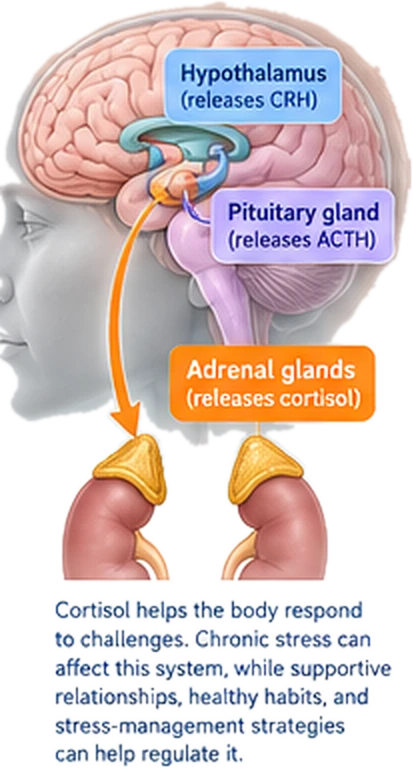
Stress hormones (HPA axis). The HPA axis is a key hormonal stress pathway. The hypothalamus and pituitary gland signal the adrenal glands to release cortisol, which helps the body mobilise energy. Feedback loops normally switch the response off. Cortisol patterns vary with the type and length of stress and with the person.
Cortisol in PTSD. Findings are inconsistent. They seem to depend on how long ago the stress occurred, on age and sex, and on how cortisol is measured (saliva, blood or hair). Early cortisol has not reliably predicted who develops PTSD. For this reason, a cortisol result is not used on its own to diagnose a mental health condition.
Autonomic nervous system. This system runs automatic body functions such as heart rate. Across studies, heart-rate variability usually changes during stress, most often in a pattern that suggests lower calming (parasympathetic) activity. Researchers use it as a marker in studies. It is not a stand-alone test of stress in one person. You can read more in Your Nervous System.
Learning and fear. Parts of the fear-learning circuit are studied closely in PTSD. These are the amygdala, hippocampus and medial prefrontal cortex. PTSD is seen partly as fear processing that has become dysregulated. This is one theoretical account. See also Your Brain Under Stress.
Memory. Trauma history and PTSD are associated with less specific autobiographical memories. This describes group averages. It does not mean trauma memories are generally unreliable or lost.
Regulation. When people deliberately regulate emotion, for example by reframing a situation, imaging studies often show parts of the prefrontal cortex becoming active. The ventrolateral region is the one most often seen. This is association, not proof that one region does the regulating alone.
The HPA axis. Simplified educational illustration; labels in the image are in English. The wording in the image is simplified.Describe this illustration
A side view of a head with the brain showing. The hypothalamus and the pituitary gland are labelled near the middle of the brain. An orange arrow runs down to the adrenal glands, which sit on top of the kidneys. A box at the bottom says what cortisol does. CRH and ACTH are the names of the hormones that carry the signals: corticotropin-releasing hormone and adrenocorticotropic hormone.
Labels in the image
Hypothalamus (releases CRH)
Pituitary gland (releases ACTH)
Adrenal glands (releases cortisol)
Cortisol helps the body respond to challenges. Chronic stress can affect this system, while supportive relationships, healthy habits, and stress-management strategies can help regulate it.
Trauma and chronic pain
Research-informed
In a large review, about 1 in 10 people with chronic pain had PTSD on average. In studies that used clinical interviews, it was about 1 in 20. Differences between studies and pain types were very large.
The figure was higher in clinic-based samples and in widespread pain. In non-clinical samples, it was unclear whether PTSD was more common among people with chronic pain than in the general population.
Chronic pain and PTSD can occur together, but this shows an association, not which comes first. Chronic pain has many other causes. Most people with chronic pain do not have PTSD, so trauma should not be assumed to be behind pain.
A review of clinical and animal research links early-life adversity with a higher risk of some chronic pain conditions. It proposes stress-system, immune and epigenetic pathways. Much of the evidence on mechanisms comes from animal studies, so cause in people has not been shown.
To be clear: Not all chronic pain or physical illness comes from trauma. Unresolved trauma does not inevitably cause disease. Pain is real and deserves medical attention whatever its cause.
Triggers and learned associations
Research-informed
Fear can generalise. After a person learns that a cue signals danger, people with anxiety-related disorders show stronger fear responses to similar but safe cues than comparison groups do.
In one small laboratory study (18 people with PTSD), people with PTSD showed a stronger return of fear after extinction learning than trauma-exposed people without PTSD. Extinction learning means learning that a cue is no longer a danger signal. The authors suggest that difficulty holding on to learned safety might contribute to PTSD symptoms.
This is one study, and laboratory fear learning is not the same as real-life reminders. These laboratory tasks use simple cues and differ between studies. They show a tendency in groups, not what drives a reaction in your own life.
Here is an illustration, not a research finding, of how this might work. Imagine a person whose history includes repeated criticism. Years later, a manager offers calm, corrective feedback, and the person feels very distressed.
This is one way the present situation and previous learning may interact. The feedback may be fair and kind, and the person's reaction may still be strong partly because of what they learned earlier. Neither one cancels out the other.
Understanding this is not the same as being able to switch it off. For persistent triggers, support from a professional is a better route than a do-it-yourself technique.
Association, not cause. Most findings here compare groups. They show that two things go together on average, not that one caused the other in you.
Group averages are not individual predictions. ACE scores, heart-rate variability and cortisol cannot diagnose or predict what will happen to one person.
Theory. Accounts of how fear learning, memory and regulation work in PTSD are proposed models. Parts of them come from animal studies.
Mixed findings. Cortisol results in PTSD are inconsistent. Emotion regulation is measured mostly by self-report, which cannot show which comes first.
Early laboratory work. Fear-learning studies in the lab are small and differ a lot. They show group tendencies, not what drives a reaction in one person.
Treatment evidence. See the next section. It is moderate to low in quality overall, and no approach should be called proven for everyone.
Resilience. Most people show resilience or recover over time, though some have lasting symptoms. Developing symptoms is not a sign of weakness.
What helps: therapies with the most evidence
Research-informed
This is a summary of research, not advice about what you should do. Which therapy suits you depends on your situation. A professional can help you choose.
Trauma-focused CBT and EMDR have the strongest trial evidence for PTSD. The overall quality of that evidence is moderate to low.
Nearly all of the guidelines in one review (13 of 14) recommend CBT as a first-line psychological treatment.
EMDR's edge over other therapies is uncertain, because many studies are low quality.
Somatic Experiencing has promising but limited evidence. There is one small randomised trial against a waitlist, and a scoping review of mixed quality.
Body- and movement-oriented approaches, taken together, showed a medium average effect. Results differed a lot between studies.
None of these should be presented as proven, or as better than trauma-focused therapy.
Mindfulness-based programmes reduced PTSD symptoms a little to a moderate amount on average, and somewhat more against a waitlist. Most of these trials compared mindfulness with a waiting list or usual care, not with trauma-focused therapy. Across psychiatric conditions, mindfulness programmes did better than no treatment but not clearly better than established treatments. Mindfulness has not been shown to replace trauma-focused therapy.
This reflection is for noticing, not for diagnosing. It helps you slow down when a reaction feels bigger than the moment seems to call for. It is not a test, and it is not a way to work through severe trauma by yourself.
Before you begin. Choose something small or moderate, not your hardest memory. You can stop at any point.
Use the Stop and pause button whenever you like. It hides the questions and shows a grounding panel.
Do not use this tool to revisit a severe or frightening experience on your own. That is work for a trauma-informed professional.
If you feel panic, numbness, unreality or a sense of being unsafe, stop and look at something around you. If the feeling stays, reach out for support.
Grounding: coming back to the room
Reflection
You can stop at any time. A simple first step is to look around the room and name five things you can see. Or pick up an object nearby and describe its colour and shape. If paying attention to your body feels hard, skip any body part and keep your attention on what is around you.
Grounding means bringing attention to the present. People use it as a coping skill. It has not been well tested on its own in controlled studies, partly because researchers have not agreed what counts as grounding. It is offered here as something to try, not as a treatment.
Some people find focusing on the body distressing. Meditation can cause unwanted effects in some people, including anxiety, low mood and unusual experiences. People with a history of trauma may be more likely to have unpleasant effects, so trauma-informed teaching and the option to stop matter. A large study of one mindfulness programme found symptoms were not more likely to worsen than in a waiting-list group, so experiences differ a great deal.
If a practice increases distress, flashbacks or a feeling of being unreal, it is reasonable to stop, slow down or talk to a trauma-informed professional. Looking at objects in the room or moving gently may feel easier than focusing on the body.
Past or Present? Six gentle prompts
Reflection
Think of a recent moment that was small or moderate, when a reaction felt bigger than the moment seemed to call for. Choose something you feel safe thinking about. This is a reflection, not a test or an assessment, and your answers are private. You can stop at any time, and use Stop and pause whenever you like. If you share this device, leave saving off, or use Clear my entries when you finish.
Everything you write here stays on your device. You can clear everything you have written on this site below, or from the Journal page.
Your entries on this device
Everything you write in these reflections is stored only in this browser, on this device. You can remove all of it here.
When to ask for help
Research-informed
Consider talking with a trauma-informed professional if distress, avoidance, nightmares, feeling numb or on edge, or feeling detached affects your sleep, work, relationships or daily life, or if you feel unsafe. Seeking help is a reasonable step, not a sign that you have failed. If a partner, family member or someone close to you makes you feel unsafe, a trained advocate or professional can help you plan, and it is fine to do that before anything else.
If you are in crisis or thinking about suicide, call or text 988 in the United States or Canada (chat in the US at 988lifeline.org). In the UK or Ireland, call Samaritans on 116 123. In Australia, call Lifeline on 13 11 14. In New Zealand, call or text 1737. These lines are free to call from most phones and open 24 hours a day. Elsewhere, find a local helpline at findahelpline.com. If someone is in immediate danger, call your local emergency number.
If you are in crisis or thinking about suicide, call or text 988 in the United States or Canada (chat in the US at 988lifeline.org). In the UK or Ireland, call Samaritans on 116 123. In Australia, call Lifeline on 13 11 14. In New Zealand, call or text 1737. These lines are free to call from most phones and open 24 hours a day. Elsewhere, find a local helpline at findahelpline.com. If someone is in immediate danger, call your local emergency number.
Sources and further reading
Aldao, A., Gee, D. G., De Los Reyes, A., & Seager, I. (2016). Emotion regulation as a transdiagnostic factor in the development of internalizing and externalizing psychopathology: Current and future directions. Development and Psychopathology, 28(4pt1), 927-946. Source Emotion regulation as a transdiagnostic factor; mixed findings in an earlier review.
Baldwin, J. R., Caspi, A., Meehan, A. J., Ambler, A., Arseneault, L., Fisher, H. L., Harrington, H., Matthews, T., Odgers, C. L., Poulton, R., Ramrakha, S., Moffitt, T. E., & Danese, A. (2021). Population vs Individual Prediction of Poor Health From Results of Adverse Childhood Experiences Screening. JAMA Pediatrics, 175(4), 385. Source ACE scores predict individual outcomes only slightly better than chance.
Baldwin, J. R., Reuben, A., Newbury, J. B., & Danese, A. (2019). Agreement Between Prospective and Retrospective Measures of Childhood Maltreatment. JAMA Psychiatry, 76(6), 584. Source Weak agreement between prospective and retrospective measures of maltreatment.
Beckers, T., Hermans, D., Lange, I., Luyten, L., Scheveneels, S., & Vervliet, B. (2023). Understanding clinical fear and anxiety through the lens of human fear conditioning. Nature Reviews Psychology, 2(4), 233-245. Source Limits of linking laboratory fear conditioning to clinical presentation.
Bethell, C., Jones, J., Gombojav, N., Linkenbach, J., & Sege, R. (2019). Positive Childhood Experiences and Adult Mental and Relational Health in a Statewide Sample. JAMA Pediatrics, 173(11), e193007. Source One US state survey of positive childhood experiences and adult depression or poor mental health.
Brewin, C. R., Cloitre, M., Hyland, P., Shevlin, M., Maercker, A., Bryant, R. A., Humayun, A., Jones, L. M., Kagee, A., Rousseau, C., Somasundaram, D., Suzuki, Y., Wessely, S., van Ommeren, M., & Reed, G. M. (2017). A review of current evidence regarding the ICD-11 proposals for diagnosing PTSD and complex PTSD. Clinical Psychology Review, 58, 1-15. Source DSM and ICD-11 descriptions of PTSD and complex PTSD compared; the DSM has no separate complex PTSD diagnosis.
Brewin, C. R., Cloitre, M., Hyland, P., Shevlin, M., Maercker, A., Bryant, R. A., Humayun, A., Jones, L. M., Kagee, A., Rousseau, C., Somasundaram, D., Suzuki, Y., Wessely, S., van Ommeren, M., & Reed, G. M. (2017). A review of current evidence regarding the ICD-11 proposals for diagnosing PTSD and complex PTSD. Clinical Psychology Review, 58, 1-15. Source Review of the ICD-11 descriptions of PTSD and complex PTSD.
Britton, W. B., Lindahl, J. R., Cooper, D. J., Canby, N. K., & Palitsky, R. (2021). Defining and Measuring Meditation-Related Adverse Effects in Mindfulness-Based Programs. Clinical Psychological Science, 9(6), 1185-1204. Source Meditation-related adverse effects in an interview study of a mindfulness programme.
Brom, D., Stokar, Y., Lawi, C., Nuriel‐Porat, V., Ziv, Y., Lerner, K., & Ross, G. (2017). Somatic experiencing for posttraumatic stress disorder: A randomized controlled outcome study. Journal of Traumatic Stress, 30(3), 304–312. Source One randomised trial of Somatic Experiencing.
Burke, N. N., Finn, D. P., McGuire, B. E., & Roche, M. (2017). Psychological stress in early life as a predisposing factor for the development of chronic pain: Clinical and preclinical evidence and neurobiological mechanisms. Journal of Neuroscience Research, 95(6), 1257-1270. Source Early-life stress and some chronic pain conditions.
Canby, N. K., Cosby, E. A., Palitsky, R., Kaplan, D. M., Lee, J., Mahdavi, G., Lopez, A. A., Goldman, R. E., Eichel, K., Lindahl, J. R., & Britton, W. B. (2025). Childhood trauma and subclinical PTSD symptoms predict adverse effects and worse outcomes across two mindfulness-based programs for active depression. PLOS ONE, 20(1), e0318499. Source Trauma history and subclinical PTSD symptoms predicted unwanted effects of mindfulness programmes.
Clamor, A., Lincoln, T. M., & Schulze, L. (2026). Emotion regulation in mental disorders: A systematic review and multilevel meta-analysis of transdiagnostic and disorder-specific impairments. Psychological Bulletin, 152(2), 157-200. Source 2026 meta-analysis: emotion-regulation difficulty across mental health conditions (self-report, group comparison).
Cloitre, M., Shevlin, M., Brewin, C. R., Bisson, J. I., Roberts, N. P., Maercker, A., Karatzias, T., & Hyland, P. (2018). The International Trauma Questionnaire: development of a self‐report measure of ICD‐11 PTSD and complex PTSD. Acta Psychiatrica Scandinavica, 138(6), 536-546. Source Questionnaire measuring ICD-11 PTSD and complex PTSD symptom groups.
Cooper, S. E., van Dis, E. A. M., Hagenaars, M. A., Krypotos, A. M., Nemeroff, C. B., Lissek, S., Engelhard, I. M., & Dunsmoor, J. E. (2022). A meta-analysis of conditioned fear generalization in anxiety-related disorders. Neuropsychopharmacology, 47(9), 1652-1661. Source Fear generalisation to safe cues.
Cuijpers, P., van Veen, S. C., Sijbrandij, M., Yoder, W., & Cristea, I. A. (2020). Eye movement desensitization and reprocessing for mental health problems: A systematic review and meta-analysis. Cognitive Behaviour Therapy, 49(3), 165–180. Source Trial evidence for PTSD therapies.
Epel, E. S., Crosswell, A. D., Mayer, S. E., Prather, A. A., Slavich, G. M., Puterman, E., & Mendes, W. B. (2018). More than a feeling: A unified view of stress measurement for population science. Frontiers in Neuroendocrinology, 49, 146-169. Source Acute, event-based, daily and chronic stress are distinct.
Farias, M., Maraldi, E., Wallenkampf, K. C., & Lucchetti, G. (2020). Adverse events in meditation practices and meditation‐based therapies: a systematic review. Acta Psychiatrica Scandinavica, 142(5), 374-393. Source Unwanted effects of meditation in a systematic review.
Fritz, J., de Graaff, A. M., Caisley, H., van Harmelen, A. L., & Wilkinson, P. O. (2018). A Systematic Review of Amenable Resilience Factors That Moderate and/or Mediate the Relationship Between Childhood Adversity and Mental Health in Young People. Frontiers in Psychiatry, 9, 230. Source Systematic review of factors linked to better mental health after adversity in young people.
Galatzer-Levy, I. R., Huang, S. H., & Bonanno, G. A. (2018). Trajectories of resilience and dysfunction following potential trauma: A review and statistical evaluation. Clinical Psychology Review, 63, 41-55. Source Resilience, recovery and chronic trajectories are averages, mostly after single events.
Galatzer-Levy, I. R., Huang, S. H., & Bonanno, G. A. (2018). Trajectories of resilience and dysfunction following potential trauma: A review and statistical evaluation. Clinical Psychology Review, 63, 41-55. Source Resilience, recovery, chronic and delayed trajectories after potentially traumatic events.
Goldberg, S. B., Tucker, R. P., Greene, P. A., Davidson, R. J., Wampold, B. E., Kearney, D. J., & Simpson, T. L. (2018). Mindfulness-based interventions for psychiatric disorders: A systematic review and meta-analysis. Clinical Psychology Review, 59, 52-60. Source Mindfulness programmes versus no treatment and versus established treatments across psychiatric conditions.
Goldberg, S. B., Tucker, R. P., Greene, P. A., Davidson, R. J., Wampold, B. E., Kearney, D. J., & Simpson, T. L. (2018). Mindfulness-based interventions for psychiatric disorders: A systematic review and meta-analysis. Clinical Psychology Review, 59, 52-60. Source Mindfulness-based interventions compared with other treatments (not PTSD-specific).
Hammond, J., & Brown, W. J. (2025). Building an Operational Definition of Grounding. Trauma, Violence, & Abuse, 27(4), 1340-1353. Source Grounding is not clearly defined and has been little tested on its own.
Herman, J. P., McKlveen, J. M., Ghosal, S., Kopp, B., Wulsin, A., Makinson, R., Scheimann, J., & Myers, B. (2016). Regulation of the hypothalamic-pituitary-adrenocortical stress response. Comprehensive Physiology, 603–621. Source The HPA axis and cortisol.
Hirshberg, M. J., Goldberg, S. B., Rosenkranz, M., & Davidson, R. J. (2022). Prevalence of harm in mindfulness-based stress reduction. Psychological Medicine, 52(6), 1080-1088. Source Symptoms did not worsen more than in a waiting-list group in a large study of MBSR.
Hopwood, T. L., & Schutte, N. S. (2017). A meta-analytic investigation of the impact of mindfulness-based interventions on post traumatic stress. Clinical Psychology Review, 57, 12-20. Source Mindfulness-based interventions for PTSD symptoms.
Hopwood, T. L., & Schutte, N. S. (2017). A meta-analytic investigation of the impact of mindfulness-based interventions on post traumatic stress. Clinical Psychology Review, 57, 12-20. Source Mindfulness-based programmes for PTSD symptoms: effect sizes and comparators.
Hughes, K., Bellis, M. A., Hardcastle, K. A., Sethi, D., Butchart, A., Mikton, C., Jones, L., & Dunne, M. P. (2017). The effect of multiple adverse childhood experiences on health: a systematic review and meta-analysis. The Lancet Public Health, 2(8), e356-e366. Source ACEs and average health risk across groups.
Kessler, R. C., Aguilar-Gaxiola, S., Alonso, J., Benjet, C., Bromet, E. J., Cardoso, G., Degenhardt, L., de Girolamo, G., Dinolova, R. V., Ferry, F., Florescu, S., Gureje, O., Haro, J. M., Huang, Y., Karam, E. G., Kawakami, N., Lee, S., Lepine, J. P., Levinson, D., ... Koenen, K. C. (2017). Trauma and PTSD in the WHO World Mental Health Surveys. European Journal of Psychotraumatology, 8(sup5), 1353383. Source How common trauma exposure and PTSD are in World Health Organization surveys; risk by type of event.
Kessler, R. C., Aguilar-Gaxiola, S., Alonso, J., Benjet, C., Bromet, E. J., Cardoso, G., Degenhardt, L., de Girolamo, G., Dinolova, R. V., Ferry, F., Florescu, S., Gureje, O., Haro, J. M., Huang, Y., Karam, E. G., Kawakami, N., Lee, S., Lepine, J.-P., Levinson, D., . . . Koenen, K. C. (2017). Trauma and PTSD in the WHO World Mental Health Surveys. European Journal of Psychotraumatology, 8(sup5), 1353383. Source Event types and PTSD risk; very common events still account for a share of all cases.
Kim, H.-G., Cheon, E.-J., Bai, D.-S., Lee, Y. H., & Koo, B.-H. (2018). Stress and heart rate variability: A meta-analysis and review of the literature. Psychiatry Investigation, 15(3), 235–245. Source Heart-rate variability as a research marker.
Kivimäki, M., & Steptoe, A. (2018). Effects of stress on the development and progression of cardiovascular disease. Nature Reviews Cardiology, 15(4), 215-229. Source Stress and cardiovascular disease: adult effects smaller than childhood adversity.
Koenen, K. C., Ratanatharathorn, A., Ng, L., McLaughlin, K. A., Bromet, E. J., Stein, D. J., Karam, E. G., Meron Ruscio, A., Benjet, C., Scott, K., Atwoli, L., Petukhova, M., Lim, C. C. W., Aguilar-Gaxiola, S., Al-Hamzawi, A., Alonso, J., Bunting, B., Ciutan, M., de Girolamo, G., . . . Kessler, R. C. (2017). Posttraumatic stress disorder in the World Mental Health Surveys. Psychological Medicine, 47(13), 2260-2274. Source Lifetime PTSD figures in World Mental Health Surveys; the survey event list is broader than the diagnostic definition.
Koenen, K. C., Ratanatharathorn, A., Ng, L., McLaughlin, K. A., Bromet, E. J., Stein, D. J., Karam, E. G., Meron Ruscio, A., Benjet, C., Scott, K., Atwoli, L., Petukhova, M., Lim, C. C., Aguilar-Gaxiola, S., Al-Hamzawi, A., Alonso, J., Bunting, B., Ciutan, M., de Girolamo, G., ... Kessler, R. C. (2017). Posttraumatic stress disorder in the World Mental Health Surveys. Psychological Medicine, 47(13), 2260-2274. Source Survey evidence that most exposed people do not develop PTSD; about half of PTSD cases persist.
Kuhfuß, M., Maldei, T., Hetmanek, A., & Baumann, N. (2021). Somatic experiencing – effectiveness and key factors of a body-oriented trauma therapy: A scoping literature review. European Journal of Psychotraumatology, 12(1), 1929023. Source Scoping review of Somatic Experiencing.
Lacey, R. E., & Minnis, H. (2020). Practitioner Review: Twenty years of research with adverse childhood experience scores – Advantages, disadvantages and applications to practice. Journal of Child Psychology and Psychiatry, 61(2), 116-130. Source Advantages and disadvantages of ACE scores.
Lewis, C., Roberts, N. P., Andrew, M., Starling, E., & Bisson, J. I. (2020). Psychological therapies for post-traumatic stress disorder in adults: Systematic review and meta-analysis. European Journal of Psychotraumatology, 11(1), 1729633. Source Review of randomised trials of PTSD therapies.
Lonsdorf, T. B., Menz, M. M., Andreatta, M., Fullana, M. A., Golkar, A., Haaker, J., Heitland, I., Hermann, A., Kuhn, M., Kruse, O., Meir Drexler, S., Meulders, A., Nees, F., Pittig, A., Richter, J., Römer, S., Shiban, Y., Schmitz, A., Straube, B., . . . Merz, C. J. (2017). Don’t fear ‘fear conditioning’: Methodological considerations for the design and analysis of studies on human fear acquisition, extinction, and return of fear. Neuroscience & Biobehavioral Reviews, 77, 247-285. Source Methodological variation in human fear-conditioning studies.
Lyssenko, L., Schmahl, C., Bockhacker, L., Vonderlin, R., Bohus, M., & Kleindienst, N. (2018). Dissociation in Psychiatric Disorders: A Meta-Analysis of Studies Using the Dissociative Experiences Scale. American Journal of Psychiatry, 175(1), 37-46. Source Dissociation across conditions.
Martin, A., Naunton, M., Kosari, S., Peterson, G., Thomas, J., & Christenson, J. K. (2021). Treatment guidelines for PTSD: A systematic review. Journal of Clinical Medicine, 10(18), 4175. Source Review of PTSD guidelines (13 of 14 recommend CBT first-line).
Mavranezouli, I., Megnin-Viggars, O., Daly, C., Dias, S., Welton, N. J., Stockton, S., Bhutani, G., Grey, N., Leach, J., Greenberg, N., Katona, C., El-Leithy, S., & Pilling, S. (2020). Psychological treatments for post-traumatic stress disorder in adults: A network meta-analysis. Psychological Medicine, 50(4), 542–555. Source Guidelines and therapy effectiveness for PTSD; evidence quality moderate to low.
Morawetz, C., Bode, S., Derntl, B., & Heekeren, H. R. (2017). The effect of strategies, goals and stimulus material on the neural mechanisms of emotion regulation: A meta-analysis of fMRI studies. Neuroscience & Biobehavioral Reviews, 72, 111–128. Source Brain imaging of emotion regulation strategies, including prefrontal regions.
Morris, M. C., Hellman, N., Abelson, J. L., & Rao, U. (2016). Cortisol, heart rate, and blood pressure as early markers of PTSD risk: A systematic review and meta-analysis. Clinical Psychology Review, 49, 79-91. Source Early cortisol has not reliably predicted who develops PTSD.
Ono, M., Devilly, G. J., & Shum, D. H. K. (2016). A meta-analytic review of overgeneral memory: The role of trauma history, mood, and the presence of posttraumatic stress disorder. Psychological Trauma: Theory, Research, Practice, and Policy, 8(2), 157-164. Source Less specific autobiographical memory with trauma history.
Pai, A., Suris, A., & North, C. (2017). Posttraumatic Stress Disorder in the DSM-5: Controversy, Change, and Conceptual Considerations. Behavioral Sciences, 7(1), 7. Source Description of the DSM-5 definition of a qualifying traumatic event and symptom groups.
Petruccelli, K., Davis, J., & Berman, T. (2019). Adverse childhood experiences and associated health outcomes: A systematic review and meta-analysis. Child Abuse & Neglect, 97, 104127. Source Meta-analysis of ACEs and health outcomes.
Ressler, K. J., Berretta, S., Bolshakov, V. Y., Rosso, I. M., Meloni, E. G., Rauch, S. L., & Carlezon, W. A. (2022). Post-traumatic stress disorder: Clinical and translational neuroscience from cells to circuits. Nature Reviews Neurology, 18(5), 273–288. Source Fear-learning circuit in PTSD; symptoms include re-experiencing.
Russell, G., & Lightman, S. (2019). The human stress response. Nature Reviews Endocrinology, 15(9), 525-534. Source Stress response described as protective in the short term and harmful when long-lasting.
Schindler-Gmelch, L., Capito, K., Steudte-Schmiedgen, S., Kirschbaum, C., & Berking, M. (2024). Hair Cortisol Research in Posttraumatic Stress Disorder - 10 Years of Insights and Open Questions. A Systematic Review. Current Neuropharmacology, 22(10), 1697-1719. Source Hair cortisol in PTSD: findings depend on timing and how cortisol is measured.
Schneider, M., & Schwerdtfeger, A. (2020). Autonomic dysfunction in posttraumatic stress disorder indexed by heart rate variability: a meta-analysis. Psychological Medicine, 50(12), 1937-1948. Source Heart-rate variability in PTSD as a group difference.
Siqveland, J., Hussain, A., Lindstrøm, J. C., Ruud, T., & Hauff, E. (2017). Prevalence of Posttraumatic Stress Disorder in Persons with Chronic Pain: A Meta-analysis. Frontiers in Psychiatry, 8, 164. Source Prevalence of PTSD among people with chronic pain; differs by sample and pain type.
Smith, K. E., & Pollak, S. D. (2021). Rethinking Concepts and Categories for Understanding the Neurodevelopmental Effects of Childhood Adversity. Perspectives on Psychological Science, 16(1), 67-93. Source Adding up ACEs treats different experiences as equal; kinds of experience may matter differently.
Speer, K. E., Semple, S., Naumovski, N., D'Cunha, N. M., & McKune, A. J. (2019). HPA axis function and diurnal cortisol in post-traumatic stress disorder: A systematic review. Neurobiology of Stress, 11, 100180. Source Mixed cortisol findings in PTSD.
White, W. F., Burgess, A., Dalgleish, T., Halligan, S., Hiller, R., Oxley, A., Smith, P., & Meiser-Stedman, R. (2022). Prevalence of the dissociative subtype of post-traumatic stress disorder: a systematic review and meta-analysis. Psychological Medicine, 52(9), 1629-1644. Source Dissociative subtype of PTSD; estimates vary widely between studies.
Wicking, M., Steiger, F., Nees, F., Diener, S. J., Grimm, O., Ruttorf, M., Schad, L. R., Winkelmann, T., Wirtz, G., & Flor, H. (2016). Deficient fear extinction memory in posttraumatic stress disorder. Neurobiology of Learning and Memory, 136, 116-126. Source Return of fear after extinction in a small laboratory study of PTSD.
Yang, J., Millman, L. S. M., David, A. S., & Hunter, E. C. (2023). The Prevalence of Depersonalization-Derealization Disorder: A Systematic Review. Journal of Trauma & Dissociation, 24(1), 8-41. Source Prevalence of depersonalisation-derealisation disorder and possible link with abuse.
Zorn, J. V., Schür, R. R., Boks, M. P., Kahn, R. S., Joëls, M., & Vinkers, C. H. (2017). Cortisol stress reactivity across psychiatric disorders: A systematic review and meta-analysis. Psychoneuroendocrinology, 77, 25–36. Source Stress-test cortisol responses differ by sex and diagnosis.
van de Kamp, M. M., Scheffers, M., Hatzmann, J., Emck, C., Cuijpers, P., & Beek, P. J. (2019). Body- and Movement-oriented interventions for posttraumatic stress disorder: A systematic review and Meta-analysis. Journal of Traumatic Stress, 32(6), 967–976. Source Meta-analysis of body- and movement-oriented interventions for PTSD.
Within Your Light provides psychoeducation. This page is for educational purposes only and is not medical advice, diagnosis, or treatment. Please talk with a licensed professional about your own health. If you are in crisis, call or text 988 in the United States, or use your local emergency number or findahelpline.com.