Your body gives off many signals: a fast heartbeat, a tight jaw, a warm face, a hollow feeling in the stomach. This page looks at what researchers know about sensing those signals and how they may relate to emotions. It also looks at what they do not know. Nothing here is a diagnosis, and you are free to skip anything.
About 28 min read
A note on safety. Paying attention to the body feels calming for some people and uncomfortable for others. Both are common.
You are not required to focus on your body. The exercise below offers other ways in, and skipping is fine.
If body focus increases distress, panic, flashbacks or a feeling of being unreal, stop and look at something around you or move gently. Consider talking with a trauma-informed professional.
Body sensations can have many causes, including medical ones. New, strong or worrying physical symptoms deserve medical attention, not interpretation on this page.
What this page covers
Research-informed
Interoception is the sensing and interpreting of signals from inside the body, and it comes in more than one form.
Emotions involve the body, thoughts and context together, and a single sensation does not have a single meaning.
Mindfulness helps some people, has limits, and can cause unwanted effects in some.
The gut and brain communicate, but research on gut bacteria and mental health is early, and it cannot yet show whether changing gut bacteria would treat mental health conditions.
The research on lying shows that people are not very accurate at telling whether someone is lying from their behaviour. It does not tell us how reliable gut feelings are in general. A bad feeling is information to check, not a verdict, and it is reasonable to act cautiously if you feel unsafe.
Interoception: sensing the inside of the body
Research-informed
Interoception is the sensing and interpreting of signals from inside the body, such as heartbeat, hunger or breath. It is thought to contribute to emotional experience, and it is studied across many mental health conditions.
Researchers describe several facets of interoception. Terms are used differently across studies, and three that are easy to confuse are:
Accuracy: how well you detect a signal, such as your heartbeat, in a test.
Insight (sometimes called awareness): how well your confidence matches your accuracy.
Sensibility: how you rate your own body sensing on a questionnaire.
These are different things. Questionnaires that ask people to rate their own body awareness often do not agree with one another, which suggests they measure different things. Self-ratings should not be assumed to tell you how accurately someone detects signals in a test.
Even this three-way split is under debate. Researchers are still working out how best to define and measure interoception.
Limits of heartbeat tests
Research-informed
A meta-analysis of 55 studies found no overall link between anxiety and how accurately people detect their heartbeat. So heartbeat accuracy scores should not be read as a measure of anxiety. Other aspects of body sensing may still matter and are less studied.
The commonly used heartbeat counting score mostly reflects under-counting and is tied to resting heart rate. It may be a weak measure of body awareness.
Alexithymia and body signals
Research-informed
People who find it hard to name their feelings (alexithymia) tend to rate their body awareness as less clear or less trustworthy. Whether they detect body signals less accurately in tests is less certain, partly because those tests are imperfect.
This association does not show which comes first, and it does not mean something is wrong with them.
Emotional awareness, arousal and regulation
Research-informed
Emotional awareness means noticing and naming what you feel. Arousal means how activated the body feels, from calm to keyed up. Researchers have proposed several models of how these fit together.
One appraisal model proposes that emotion begins with how a person evaluates an event. Bodily changes, action urges and then a conscious feeling and label follow. It is one model among several.
The theory of constructed emotion proposes that the brain builds emotions from predictions and bodily signals, rather than triggering fixed emotion circuits. It is a theory still under discussion among researchers, not an established fact.
Emotion regulation is the way people influence what they feel. Reappraisal means changing how you think about a situation. It is often effective for managing emotion, but how well it works depends on the person and the context.
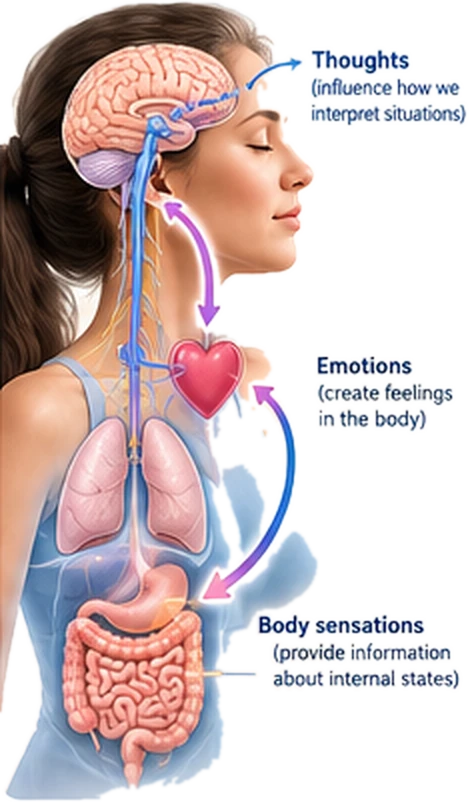
Thoughts, emotions and body sensations. Simplified educational illustration; labels in the image are in English. The wording in the image is simplified. As this page explains, a sensation does not have one meaning.Describe this illustration
A side view of a woman with her eyes closed. Her brain, heart, lungs, stomach and intestines are shown, joined by nerves. Curved arrows link three labelled ideas: thoughts near the brain, emotions near the heart and body sensations near the stomach.
Labels in the image
Thoughts (influence how we interpret situations)
Emotions (create feelings in the body)
Body sensations (provide information about internal states)
Difficulty regulating emotion shows up across almost all mental health conditions studied. This comes from a 2026 meta-analysis of questionnaire studies. These are group comparisons measured by self-report, so they cannot show which comes first. It is best seen as one contributing factor among several.
Body sensations can show that you feel aroused, but the same pattern can accompany different emotions. A physical reaction alone does not tell you why you feel it.
A large meta-analysis looked at 202 laboratory studies of automatic body responses, such as heart rate and sweating. It found no clear, distinct pattern for each emotion category, and wide variation within categories. The authors read this as more consistent with constructed emotion. That interpretation is contested.
The brain is thought to infer what causes bodily signals, using prediction. This is one proposed account. If it is right, those guesses can sometimes be wrong, so the same sensation could be interpreted in more than one way.
Gut feelings: The research on lying finds that the behavioural cues people rely on, such as avoiding eye contact, are faint and unreliable. People are only slightly better than chance at spotting lies from behaviour. So a feeling that someone is lying is not good evidence on its own. This evidence is about lie detection only. It does not show how reliable gut feelings are in general, and it does not mean your sense of danger is wrong. A bad feeling is information to check, not a verdict. It is reasonable to act cautiously and look after yourself when you feel unsafe, and to talk with someone you trust or a professional.
Mindfulness: benefits and limits
Research-informed
Meta-analyses find that mindfulness-based programmes help some people with depression, pain and PTSD symptoms. They also reduce symptoms such as anxiety and distress in some nonclinical groups. In some comparisons, effects were similar to other evidence-based treatments. Results vary across settings and study quality, and other approaches may work as well. Researchers warn against hype and call for attention to adverse effects.
Meditation helps some people, and a small number notice unwanted effects such as anxiety, low mood or feeling unreal. In studies the rates varied a lot, depending on how they were measured. If a practice makes you feel worse, you can stop.
People with a history of trauma may be more likely to have unpleasant effects from meditation, so trauma-informed teaching and the option to stop matter. At the same time, a large study of Mindfulness-Based Stress Reduction found symptoms were not more likely to worsen than in a waiting-list group. Experiences differ a great deal.
In PTSD trials, mindfulness-based programmes reduced symptoms on average compared with control conditions (a small-to-moderate effect), with a larger effect against a waitlist. Most of these trials compared mindfulness with a waiting list or usual care, not with trauma-focused therapy. They have not been shown to replace trauma-focused care.
If a practice increases distress, flashbacks or a feeling of being unreal, it is reasonable to stop, slow down or seek a trauma-informed professional rather than push through.
Experiential avoidance and psychological flexibility
Research-informed
Acceptance and Commitment Therapy, or ACT, uses two ideas that come up often. In ACT, experiential avoidance describes steady efforts to avoid, suppress or escape unwanted feelings, thoughts or sensations. In ACT, psychological flexibility describes being able to stay in contact with the present moment and act in line with your values even when discomfort is there.
For the first idea, the research is mostly correlational. In questionnaire studies, adults with mental health conditions report more avoidance, rumination and suppression of emotions than adults without them. These studies compare groups at one time, so they cannot show which comes first. They also measure emotion-regulation habits in general, not ACT's idea of experiential avoidance specifically.
The questionnaire most often used to measure experiential avoidance, the AAQ-II, may overlap with general distress. In one online survey of 524 people, its items correlated more highly with measures of depression, anxiety and stress than a separate avoidance questionnaire did (Tyndall et al., 2019). So it is hard to say whether avoidance itself, rather than distress, explains some results.
For the second idea, ACT helps with many conditions in trials, comparable to CBT and often better than waitlist or usual care. A review of studies on depression found that ACT reduced depressive symptoms compared with control conditions on average. Among teenagers, ACT worked similarly to CBT, and greater psychological flexibility went with larger symptom reductions. Many ACT trials have a high risk of bias, and some of the reviews were written by researchers who work on ACT.
Avoiding a feeling is not always a problem. Sometimes stepping away is wise. These ideas are tools for thinking, not rules.
The gut-brain axis
Research-informed
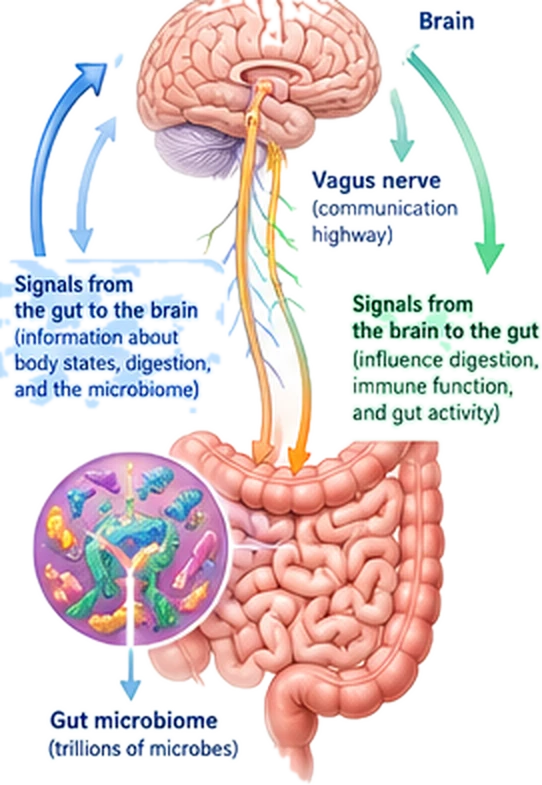
The gut and brain communicate through nerves, immune signals and substances made by gut microbes. Much of what is known comes from animal studies, and human findings are still early.
The gut-brain axis. Simplified educational illustration; labels in the image are in English. The wording in the image is simplified. Much of what is known comes from animal studies, and human findings are still early.Describe this illustration
A brain at the top and the intestines below, joined by nerve fibres. Arrows on each side show signals going from the gut to the brain and from the brain to the gut. A circle at the lower left shows the gut microbiome, drawn as many tiny microbes.
Labels in the image
Brain
Vagus nerve (communication highway)
Signals from the gut to the brain (information about body states, digestion, and the microbiome)
Signals from the brain to the gut (influence digestion, immune function, and gut activity)
Gut microbiome (trillions of microbes)
A meta-analysis finds that gut bacteria differ on average in people with several psychiatric conditions, with a shared rather than disorder-specific pattern. This does not show that gut bacteria cause these conditions. Reviews of gut bacteria in anxiety and depression find some consistent differences in the kinds of bacteria present but inconsistent results on overall diversity, and diet and medication make the findings hard to interpret. The research cannot yet show whether changing gut bacteria would prevent or treat these conditions, and no gut test is used to diagnose them.
Association. Links between alexithymia and body-signal difficulties, and between avoidance and mental health conditions, are group associations. They do not show what causes what.
Theory. Appraisal models, constructed emotion and the idea that the brain infers the causes of body signals are proposed accounts. Constructed emotion in particular is still under discussion.
Trials. Mindfulness and ACT show benefit in trials for some people and some conditions. Quality varies, and adverse effects are real.
Animal and early evidence. Much gut-brain evidence is from animals or is associative in humans.
Measurement. Heartbeat tests may be weak measures of body awareness, and body-awareness questionnaires often disagree with one another.
Try this: notice, gently
Reflection
This is an optional practice, not a test. It takes about two minutes. You choose how long, and you can stop at any point.
Sit or stand comfortably. Let your eyes rest on something in the room, or close them if that feels fine.
Breathing. Is it fast or slow, shallow or deep? You do not need to change it.
Muscle tension. Check your jaw, shoulders and hands. Is there any tightness?
Heartbeat. Can you notice it, in your chest, neck or fingertips? It is fine if you cannot.
Temperature. Do you feel warm, cool or neutral?
Comfort. Is your body comfortable, uncomfortable or in between?
Emotional state. If you like, give what you feel a word, such as calm, tense, flat or hopeful. "I am not sure" is an answer.
Noticing your heartbeat or breathing does not mean something is wrong. If noticing makes it feel faster or louder, switch to looking around the room.
If focusing on your body feels uncomfortable
Reflection
Some people find body focus distressing, especially after painful experiences. That is a reasonable response, not a failing. Here are other ways to do the same practice:
Look outward. Name five things you can see, or pick one object and describe its colour and shape.
Move. Stretch, walk, or press your feet on the floor, and notice how the movement feels, only if that is comfortable.
Shorten it. Notice one sensation for a few seconds, then stop.
Skip it. Skipping is a fine choice. You can come back another day, or choose not to.
If any version of this brings on panic, flashbacks or feeling unreal, stop and consider talking with a trauma-informed professional.
Emotional Awareness Explorer: four things that are easy to mix up
Reflection
When something stirs us up, sensation, emotion, thought and interpretation can blur together. Open any card to see an example. This is a way of thinking things through, not a test, and the examples are not diagnoses.
Sensation: what the body is doing
A sensation is a physical signal you can notice, such as a tight chest, warm face, fast heartbeat, a knot in the stomach or heavy shoulders. It can be described without saying why it is there. Example: "My chest feels tight." Sensations have multiple causes, including emotions, caffeine, exercise, illness, hunger and tiredness.
Emotion: the feeling you name
An emotion is the feeling you give a word to, such as nervous, sad, angry, ashamed, relieved or calm. Sometimes it is hard to name, and "mixed" or "not sure" are fine. Example: "I feel nervous." The same sensation can go with different emotions, and one emotion can come with different sensations.
Thought: the words in your head
A thought is a sentence your mind says, such as "I am going to mess this up" or "They are annoyed with me." Thoughts can be helpful, unhelpful, true or untrue. Example: "I am going to mess this up." A thought is not automatically a fact.
Interpretation: the meaning you give it
An interpretation is the meaning you attach to a sensation or situation. Example: "My heart is racing, so something must be wrong with me", or "My stomach dropped when he walked in, so he must be lying." The first may be an interpretation of a sensation. The second treats a gut feeling as proof about someone else. Research on lie detection finds that people are only slightly better than chance at telling lies from behaviour, so a feeling alone is weak evidence about whether someone is lying. That research does not say your sense of danger is wrong. The body can signal arousal, but it does not tell you the cause.
Putting them together: one example
Situation: you are about to speak in a meeting. Sensation: your heartbeat is fast and your hands feel cold. Emotion: nervous. Thought: "I will forget what to say." Interpretation: "My body is telling me I am not ready." Another interpretation is possible, for example: "My body is warming up for something that matters to me." Neither is a fact. This is an example of an alternative reading, not a recommended technique, and noticing the difference can leave room for choice.
Same sensation, different possible causes
A racing heart might come from climbing stairs, a strong coffee, a frightening thought, excitement, or a medical condition. If a symptom is new, strong or worrying, see a doctor instead of trying to interpret it yourself.
A short check-in
Reflection
This is a gentle check-in, not a test and not an assessment. Your answers are private. You can skip any question, use Stop and pause at any time, or answer by looking at the room instead of at your body. If you share this device, leave saving off, or use Clear my entries when you finish.
If you are in crisis or thinking about suicide, call or text 988 in the United States or Canada (chat in the US at 988lifeline.org). In the UK or Ireland, call Samaritans on 116 123. In Australia, call Lifeline on 13 11 14. In New Zealand, call or text 1737. These lines are free to call from most phones and open 24 hours a day. Elsewhere, find a local helpline at findahelpline.com. If someone is in immediate danger, call your local emergency number.
If you are in crisis or thinking about suicide, call or text 988 in the United States or Canada (chat in the US at 988lifeline.org). In the UK or Ireland, call Samaritans on 116 123. In Australia, call Lifeline on 13 11 14. In New Zealand, call or text 1737. These lines are free to call from most phones and open 24 hours a day. Elsewhere, find a local helpline at findahelpline.com. If someone is in immediate danger, call your local emergency number.
Sources and further reading
Adams, K. L., Edwards, A., Peart, C., Ellett, L., Mendes, I., Bird, G., & Murphy, J. (2022). The association between anxiety and cardiac interoceptive accuracy: A systematic review and meta-analysis. Neuroscience & Biobehavioral Reviews, 140, 104754. Source No overall link between anxiety and heartbeat detection accuracy.
Aldao, A., Gee, D. G., De Los Reyes, A., & Seager, I. (2016). Emotion regulation as a transdiagnostic factor in the development of internalizing and externalizing psychopathology: Current and future directions. Development and Psychopathology, 28(4pt1), 927-946. Source Emotion regulation as one contributing factor; earlier review noted mixed findings.
Bai, Z., Luo, S., Zhang, L., Wu, S., & Chi, I. (2020). Acceptance and commitment therapy (ACT) to reduce depression: A systematic review and meta-analysis. Journal of Affective Disorders, 260, 728-737. Source ACT and depression: reduced symptoms compared with controls.
Barrett, L. F. (2016). The theory of constructed emotion: An active inference account of interoception and categorization. Social Cognitive and Affective Neuroscience, nsw154. Source Theory of constructed emotion.
Brewer, R., Cook, R., & Bird, G. (2016). Alexithymia: a general deficit of interoception. Royal Society Open Science, 3(10), 150664. Source Alexithymia and difficulty reading body signals.
Britton, W. B., Lindahl, J. R., Cooper, D. J., Canby, N. K., & Palitsky, R. (2021). Defining and Measuring Meditation-Related Adverse Effects in Mindfulness-Based Programs. Clinical Psychological Science, 9(6), 1185-1204. Source Meditation-related adverse effects in an interview study of a mindfulness programme.
Canby, N. K., Cosby, E. A., Palitsky, R., Kaplan, D. M., Lee, J., Mahdavi, G., Lopez, A. A., Goldman, R. E., Eichel, K., Lindahl, J. R., & Britton, W. B. (2025). Childhood trauma and subclinical PTSD symptoms predict adverse effects and worse outcomes across two mindfulness-based programs for active depression. PLOS ONE, 20(1), e0318499. Source Trauma history and subclinical PTSD symptoms predicted unwanted effects of mindfulness programmes.
Clamor, A., Lincoln, T. M., & Schulze, L. (2026). Emotion regulation in mental disorders: A systematic review and multilevel meta-analysis of transdiagnostic and disorder-specific impairments. Psychological Bulletin, 152(2), 157-200. Source 2026 meta-analysis: avoidance, rumination and suppression in mental health conditions (self-report, group comparison).
Cryan, J. F., O'Riordan, K. J., Cowan, C. S. M., Sandhu, K. V., Bastiaanssen, T. F. S., Boehme, M., Codagnone, M. G., Cussotto, S., Fulling, C., Golubeva, A. V., Guzzetta, K. E., Jaggar, M., Long-Smith, C. M., Lyte, J. M., Martin, J. A., Molinero-Perez, A., Moloney, G., Morelli, E., Morillas, E., ... Dinan, T. G. (2019). The Microbiota-Gut-Brain Axis. Physiological Reviews, 99(4), 1877-2013. Source Gut-brain communication; much evidence from animals.
Desmedt, O., Heeren, A., Corneille, O., & Luminet, O. (2022). What do measures of self-report interoception measure? Insights from a systematic review, latent factor analysis, and network approach. Biological Psychology, 169, 108289. Source Self-report interoception questionnaires show low agreement with one another.
Desmedt, O., Luminet, O., Maurage, P., & Corneille, O. (2025). Discrepancies in the Definition and Measurement of Human Interoception: A Comprehensive Discussion and Suggested Ways Forward. Perspectives on Psychological Science, 20(1), 76-98. Source Interoception is defined and measured inconsistently.
Farias, M., Maraldi, E., Wallenkampf, K. C., & Lucchetti, G. (2020). Adverse events in meditation practices and meditation‐based therapies: a systematic review. Acta Psychiatrica Scandinavica, 142(5), 374-393. Source Unwanted effects of meditation in a systematic review.
Galante, J., Friedrich, C., Dawson, A. F., Modrego-Alarcón, M., Gebbing, P., Delgado-Suárez, I., Gupta, R., Dean, L., Dalgleish, T., White, I. R., & Jones, P. B. (2021). Mindfulness-based programmes for mental health promotion in adults in nonclinical settings: A systematic review and meta-analysis of randomised controlled trials. PLOS Medicine, 18(1), e1003481. Source Mindfulness for nonclinical mental health promotion; results vary by setting.
Gloster, A. T., Walder, N., Levin, M. E., Twohig, M. P., & Karekla, M. (2020). The empirical status of acceptance and commitment therapy: A review of meta-analyses. Journal of Contextual Behavioral Science, 18, 181-192. Source ACT trial evidence.
Goldberg, S. B., Tucker, R. P., Greene, P. A., Davidson, R. J., Wampold, B. E., Kearney, D. J., & Simpson, T. L. (2018). Mindfulness-based interventions for psychiatric disorders: A systematic review and meta-analysis. Clinical Psychology Review, 59, 52-60. Source Mindfulness programmes did better than no treatment but not clearly better than established treatments.
Goldberg, S. B., Tucker, R. P., Greene, P. A., Davidson, R. J., Wampold, B. E., Kearney, D. J., & Simpson, T. L. (2018). Mindfulness-based interventions for psychiatric disorders: A systematic review and meta-analysis. Clinical Psychology Review, 59, 52-60. Source Mindfulness-based interventions: benefits compared with other treatments (not PTSD-specific).
Hirshberg, M. J., Goldberg, S. B., Rosenkranz, M., & Davidson, R. J. (2022). Prevalence of harm in mindfulness-based stress reduction. Psychological Medicine, 52(6), 1080-1088. Source Symptoms did not worsen more than in a waiting-list group in a large study of MBSR.
Hopwood, T. L., & Schutte, N. S. (2017). A meta-analytic investigation of the impact of mindfulness-based interventions on post traumatic stress. Clinical Psychology Review, 57, 12-20. Source Mindfulness for PTSD symptoms.
Hopwood, T. L., & Schutte, N. S. (2017). A meta-analytic investigation of the impact of mindfulness-based interventions on post traumatic stress. Clinical Psychology Review, 57, 12-20. Source Mindfulness-based programmes for PTSD symptoms: effect sizes; mostly waitlist or usual-care comparisons.
Khalsa, S. S., Adolphs, R., Cameron, O. G., Critchley, H. D., Davenport, P. W., Feinstein, J. S., Feusner, J. D., Garfinkel, S. N., Lane, R. D., Mehling, W. E., Meuret, A. E., Nemeroff, C. B., Oppenheimer, S., Petzschner, F. H., Pollatos, O., Rhudy, J. L., Schramm, L. P., Simmons, W. K., Stein, M. B., ... Zucker, N. (2018). Interoception and Mental Health: A Roadmap. Biological Psychiatry: Cognitive Neuroscience and Neuroimaging, 3(6), 501-513. Source Interoception and its facets (accuracy, insight, sensibility); terms are used inconsistently.
Luke, T. J. (2019). Lessons From Pinocchio: Cues to Deception May Be Highly Exaggerated. Perspectives on Psychological Science, 14(4), 646-671. Source Published deception-cue effects are probably inflated; cues are weak.
López-Pinar, C., Lara-Merín, L., & Macías, J. (2025). Process of change and efficacy of acceptance and commitment therapy (ACT) for anxiety and depression symptoms in adolescents: A meta-analysis of randomized controlled trials. Journal of Affective Disorders, 368, 633-644. Source ACT and psychological flexibility in teenagers.
Margolis, K. G., Cryan, J. F., & Mayer, E. A. (2021). The Microbiota-Gut-Brain Axis: From Motility to Mood. Gastroenterology, 160(5), 1486-1501. Source Microbiota-gut-brain axis review; animal work shows promise, more progress needed.
McRae, K., & Gross, J. J. (2020). Emotion regulation. Emotion, 20(1), 1–9. Source Reappraisal depends on the person and context.
Murphy, J., Brewer, R., Hobson, H., Catmur, C., & Bird, G. (2018). Is alexithymia characterised by impaired interoception? Further evidence, the importance of control variables, and the problems with the Heartbeat Counting Task. Biological Psychology, 136, 189-197. Source Alexithymia and heartbeat counting: results depend on control variables and the task's weaknesses.
Murphy, J., Catmur, C., & Bird, G. (2019). Classifying individual differences in interoception: Implications for the measurement of interoceptive awareness. Psychonomic Bulletin & Review, 26(5), 1467-1471. Source The three-way split of interoception is itself under revision.
Nikolova, V. L., Smith, M. R. B., Hall, L. J., Cleare, A. J., Stone, J. M., & Young, A. H. (2021). Perturbations in Gut Microbiota Composition in Psychiatric Disorders. JAMA Psychiatry, 78(12), 1343. Source Gut bacteria differences in psychiatric conditions.
Scherer, K. R., & Moors, A. (2019). The emotion process: Event appraisal and component differentiation. Annual Review of Psychology, 70(1), 719–745. Source Appraisal model of the emotion process.
Seth, A. K., & Friston, K. J. (2016). Active interoceptive inference and the emotional brain. Philosophical Transactions of the Royal Society B: Biological Sciences, 371(1708), 20160007. Source Theoretical review of interoceptive inference: the brain infers causes of body signals.
Siegel, E. H., Sands, M. K., Van den Noortgate, W., Condon, P., Chang, Y., Dy, J., Quigley, K. S., & Barrett, L. F. (2018). Emotion fingerprints or emotion populations? A meta-analytic investigation of autonomic features of emotion categories. Psychological Bulletin, 144(4), 343-393. Source Meta-analysis: no clear distinct autonomic pattern for each emotion; authors favour constructed emotion.
Simpson, C. A., Diaz-Arteche, C., Eliby, D., Schwartz, O. S., Simmons, J. G., & Cowan, C. S. (2021). The gut microbiota in anxiety and depression – A systematic review. Clinical Psychology Review, 83, 101943. Source Microbiota in anxiety and depression: some consistent differences, inconsistent diversity results.
Tyndall, I., Waldeck, D., Pancani, L., Whelan, R., Roche, B., & Dawson, D. L. (2019). The Acceptance and Action Questionnaire-II (AAQ-II) as a measure of experiential avoidance: Concerns over discriminant validity. Journal of Contextual Behavioral Science, 12, 278-284. Source Online survey (524 people): AAQ-II items correlated more with depression, anxiety and stress than a separate avoidance questionnaire.
Van Bael, K., Scarfo, J., Suleyman, E., Katherveloo, J., Grimble, N., & Ball, M. (2024). A systematic review and meta-analysis of the relationship between subjective interoception and alexithymia: Implications for construct definitions and measurement. PLOS ONE, 19(11), e0310411. Source Alexithymia and self-reported body awareness; accuracy in tests is less certain.
Van Dam, N. T., van Vugt, M. K., Vago, D. R., Schmalzl, L., Saron, C. D., Olendzki, A., Meissner, T., Lazar, S. W., Kerr, C. E., Gorchov, J., Fox, K. C. R., Field, B. A., Britton, W. B., Brefczynski-Lewis, J. A., & Meyer, D. E. (2018). Mind the Hype: A Critical Evaluation and Prescriptive Agenda for Research on Mindfulness and Meditation. Perspectives on Psychological Science, 13(1), 36-61. Source Mindfulness: cautions about hype and adverse effects.
Vrij, A., Hartwig, M., & Granhag, P. A. (2019). Reading Lies: Nonverbal Communication and Deception. Annual Review of Psychology, 70(1), 295-317. Source Nonverbal cues to deception are faint and unreliable; people are mediocre lie catchers.
Zamariola, G., Maurage, P., Luminet, O., & Corneille, O. (2018). Interoceptive accuracy scores from the heartbeat counting task are problematic: Evidence from simple bivariate correlations. Biological Psychology, 137, 12-17. Source Problems with the heartbeat counting score.
Within Your Light provides psychoeducation. This page is for educational purposes only and is not medical advice, diagnosis, or treatment. Please talk with a licensed professional about your own health. If you are in crisis, call or text 988 in the United States, or use your local emergency number or findahelpline.com.